ICML 2026 · FoGen Workshop

Interpreting Latent CoT Reasoning
as Dynamical Systems

Sabari Iyyappan Duraipandian1*, Shreya Sanjay Boyane2*, Manju Nagesh3*, Jerome Francis4†‡, Archana Vaidheeswaran4, Kevin Zhu4

1San Jose State University  •  2Worcester Polytechnic Institute  •  3George Mason University  •  4Algoverse AI Research

*Equal contribution  •  Project Lead  •  Corresponding author: jerome@algoverseairesearch.org

Contents

Abstract

TL;DR Latent CoT trajectories form structured dynamical systems. CODI acts as a stable attractor. COCONUT behaves as an unstable expanding system. Sim-CoT supervision tightens both.

Recent latent reasoning methods such as CODI and COCONUT face a fundamental interpretability problem. They carry multiple superimposed candidate traces in hidden space at each step, which obscures how reasoning evolves. Existing mechanistic methods reveal compression, shortcuts, and superposition but do not explain how reasoning evolves across latent steps. To address this gap, we model the sequence of latent tokens as a trajectory in representation space and apply dynamical-system analysis to characterize reasoning evolution. Using both quantitative metrics (step-to-step change, direction consistency, Lyapunov sensitivity) and qualitative projections (UMAP, DMD, PHATE), we show that latent CoT exhibits structured, non-random dynamics with two distinct stability classes. CODI behaves as a stable attractor. COCONUT behaves as an unstable expanding system. Sim-CoT supervision tightens both behaviors, handling latent instability without changing the underlying dynamics. This framework advances the interpretability of latent CoT reasoning and introduces actionable findings to catalyze further research.

Method

We propose a framework for analyzing latent chain-of-thought reasoning as a dynamical system. Given an input, a latent CoT model produces a sequence of hidden states $z_1, z_2, \ldots, z_T$ across $T = 6$ reasoning steps. We treat this sequence as a trajectory in representation space. Four model configurations are analyzed: CODI and COCONUT, each in Vanilla and Sim-CoT settings, all trained on GPT-2-small backbones using the GSM8K benchmark.
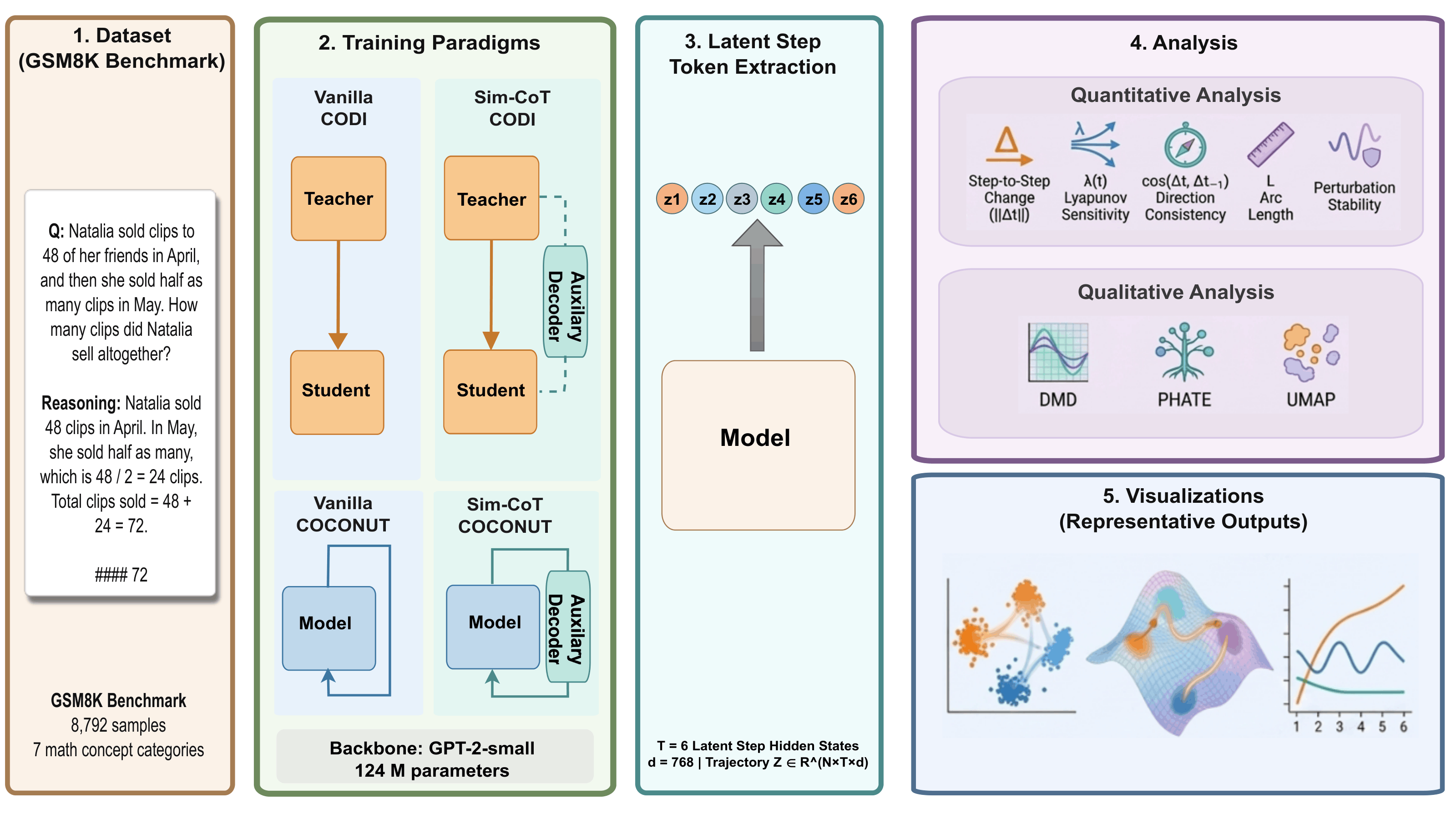
Dynamical System Analysis Framework
Overview of our analysis framework. (1) GSM8K dataset. (2) Four model configurations. (3) Six latent hidden states forming a trajectory in representation space. (4) Quantitative metrics and qualitative projections. (5) Latent space and dynamics visualizations.

We characterize trajectories using two groups of metrics. Step-based metrics measure how trajectories move between consecutive steps: step-to-step change $\|\Delta_t\| = \|z_{t+1} - z_t\|_2$, direction consistency $C_t = \cos(\Delta_t, \Delta_{t-1})$, and arc length $L = \sum_{t} \|z_{t+1} - z_t\|_2$. Stability metrics capture sensitivity and convergence: a Lyapunov surrogate $\lambda(t) = \log(\|\Delta_{t+1}\| / \|\Delta_t\|)$ and perturbation divergence under Gaussian noise injection. For qualitative analysis, we project trajectories using DMD, PHATE, UMAP, PCA, and t-SNE, then visualize them as sequences of points with temporal ordering preserved.
Quantitative Analysis

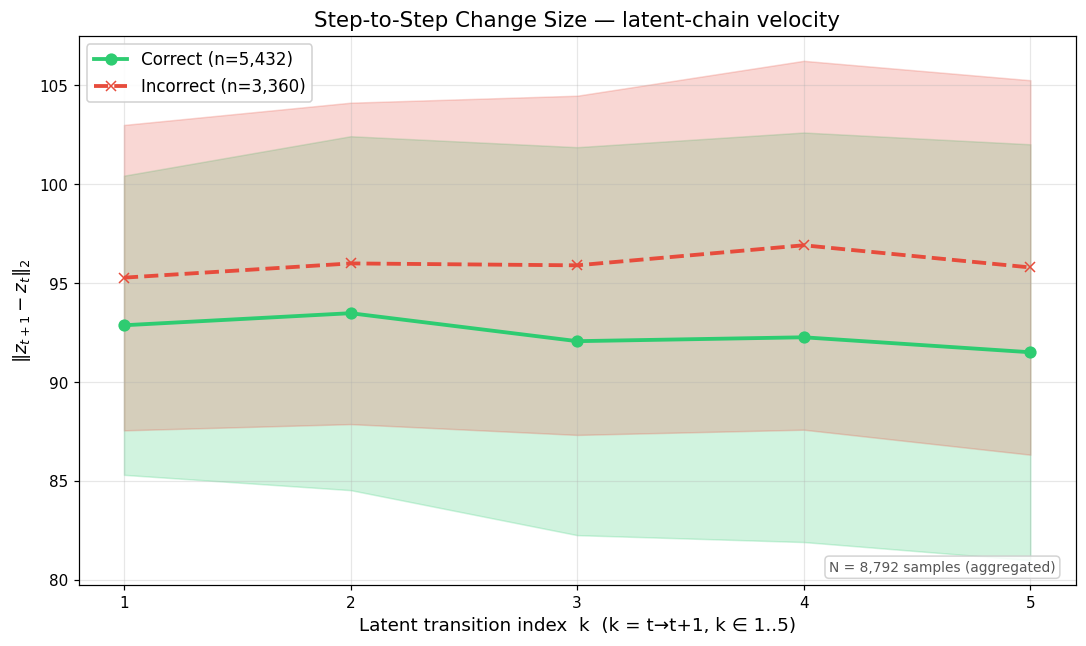
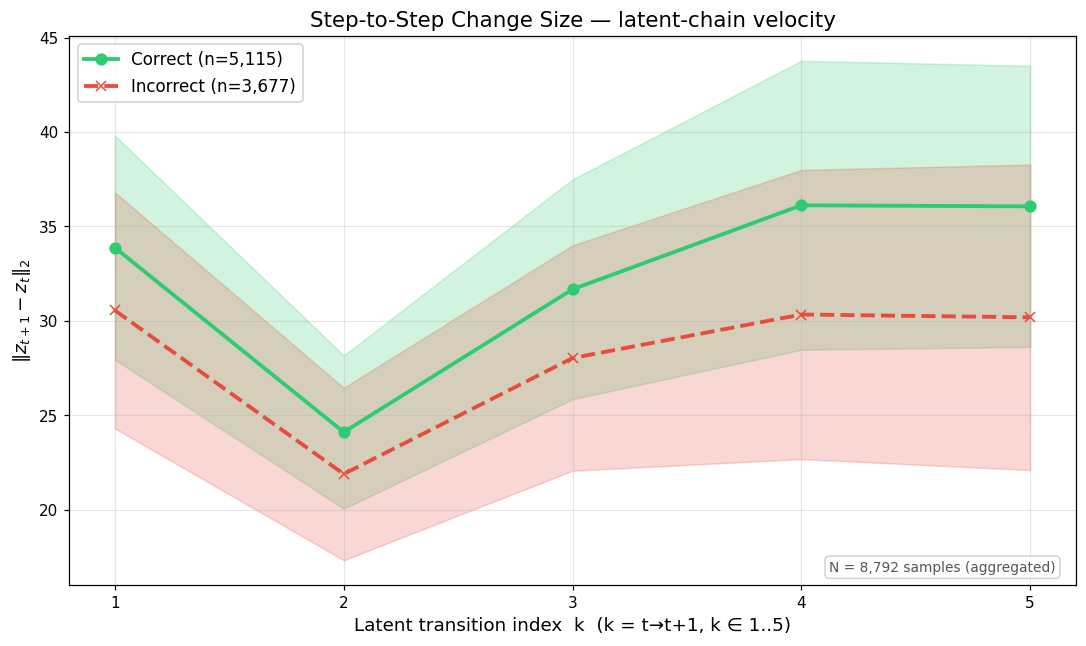
Metrics are computed directly on the original high-dimensional representations. Each 2×2 grid compares CODI and COCONUT under Vanilla and Sim-CoT training.

Step-to-Step Change

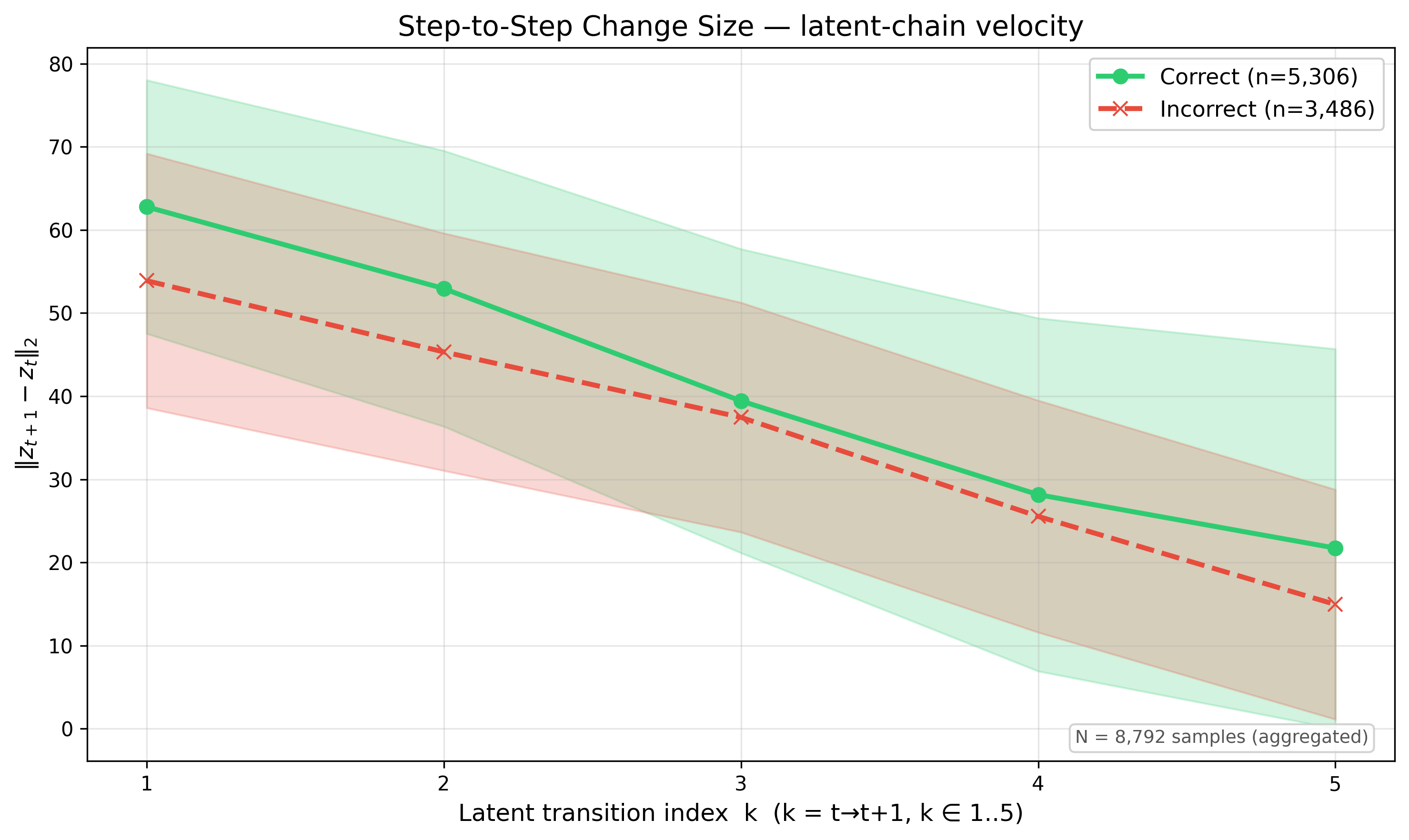
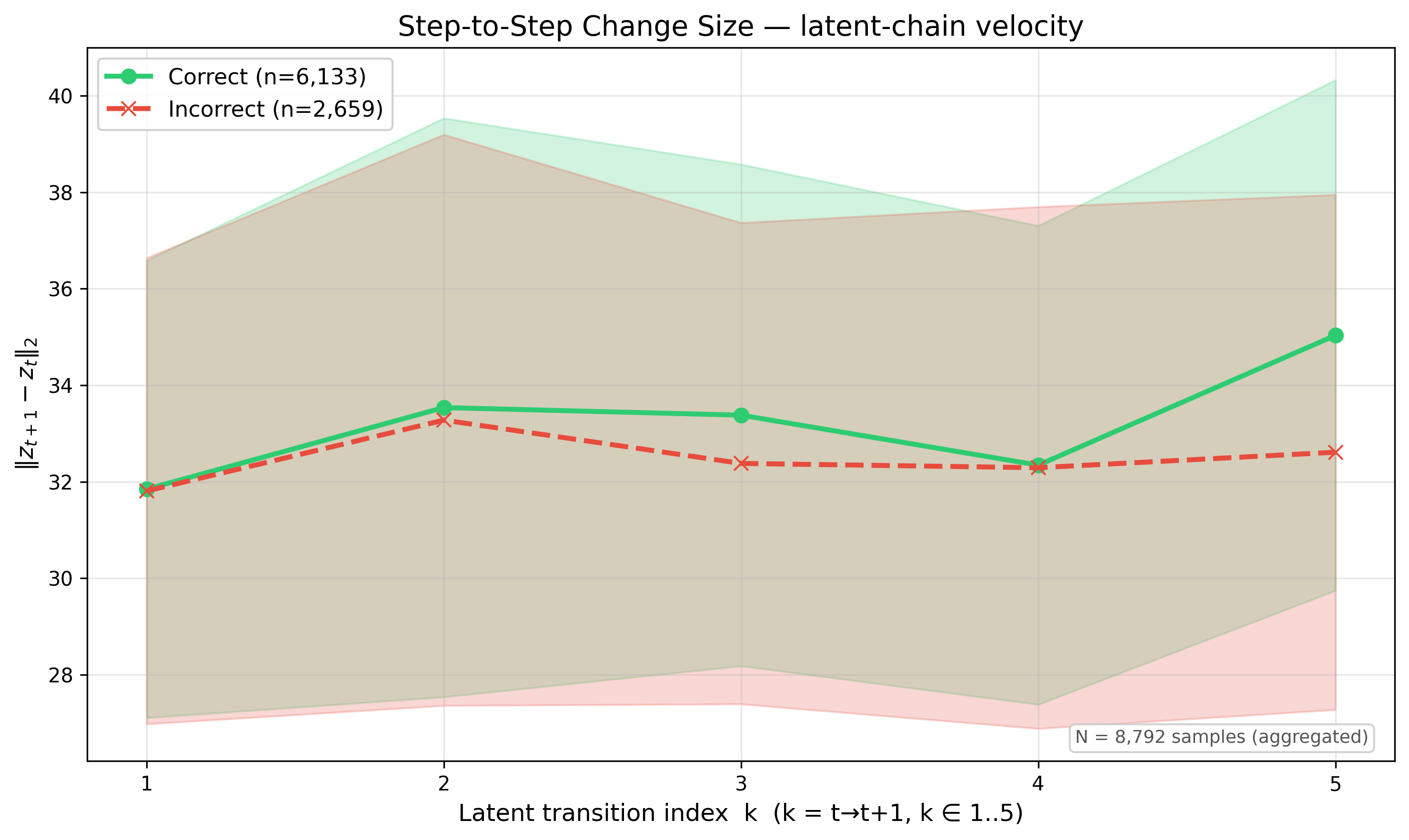
CODI shows a uniform curve with variance in the Vanilla setting. Under Sim-CoT, it becomes monotonically decreasing, suggesting convergence in the final phase. COCONUT shows a premature drop from step 2 to 3 in Vanilla, then stabilizes under Sim-CoT. CODI exhibits more stable transitions overall.

CODI
COCONUT
Vanilla
Step2Step CODI Vanilla
Step2Step COCONUT Vanilla
Sim-CoT
Step2Step CODI SimCoT
Step2Step COCONUT SimCoT

Lyapunov Sensitivity

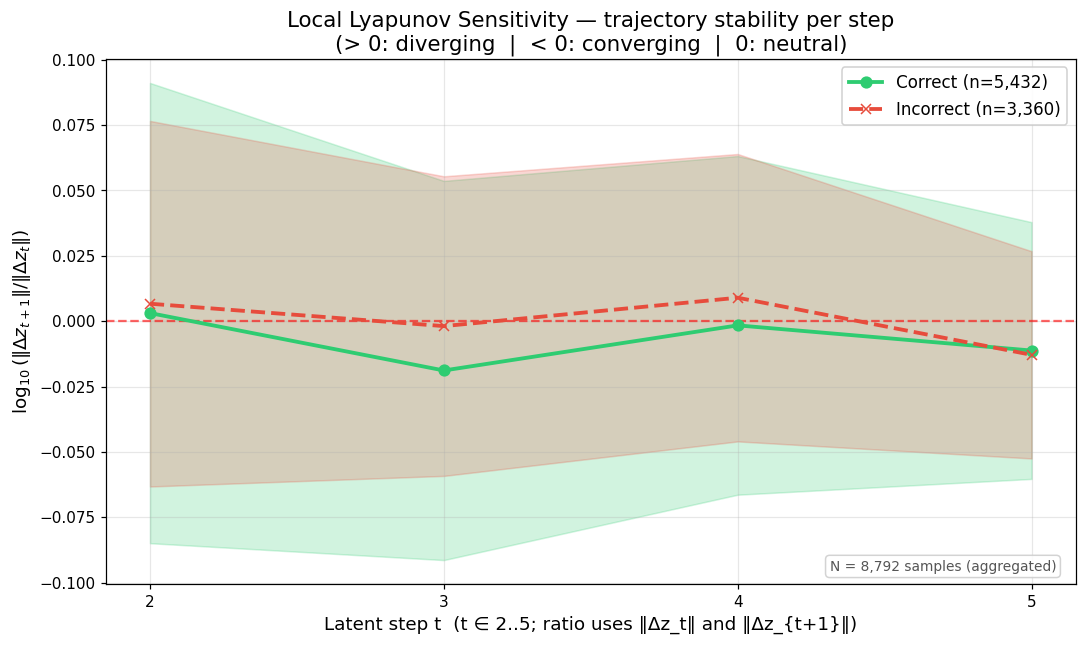
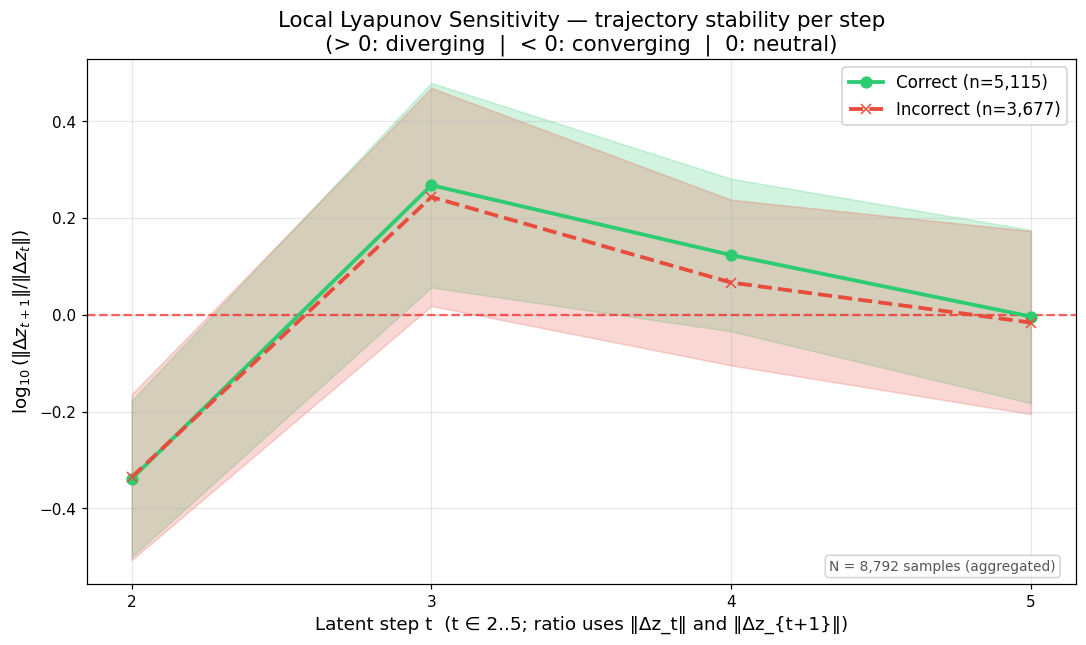
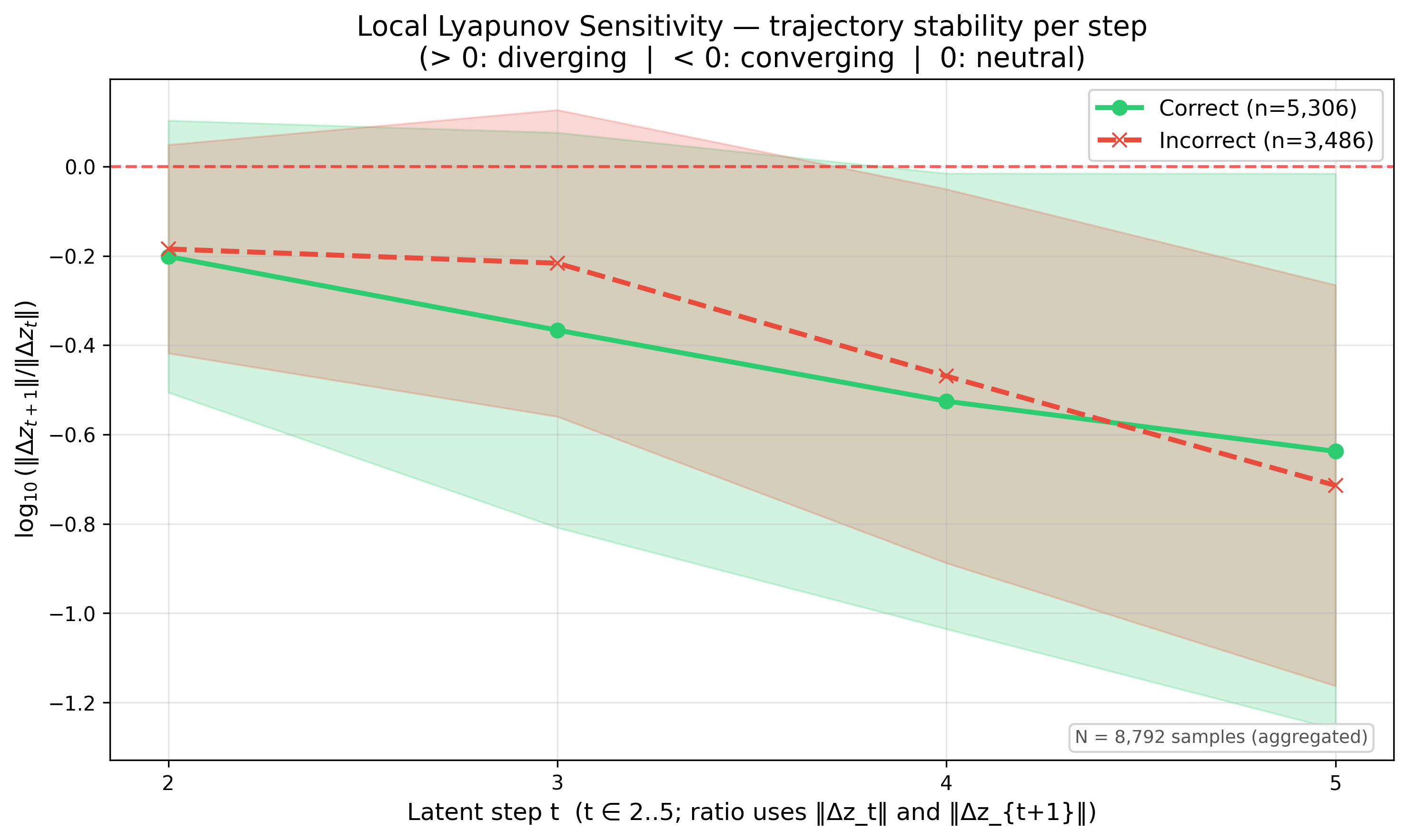
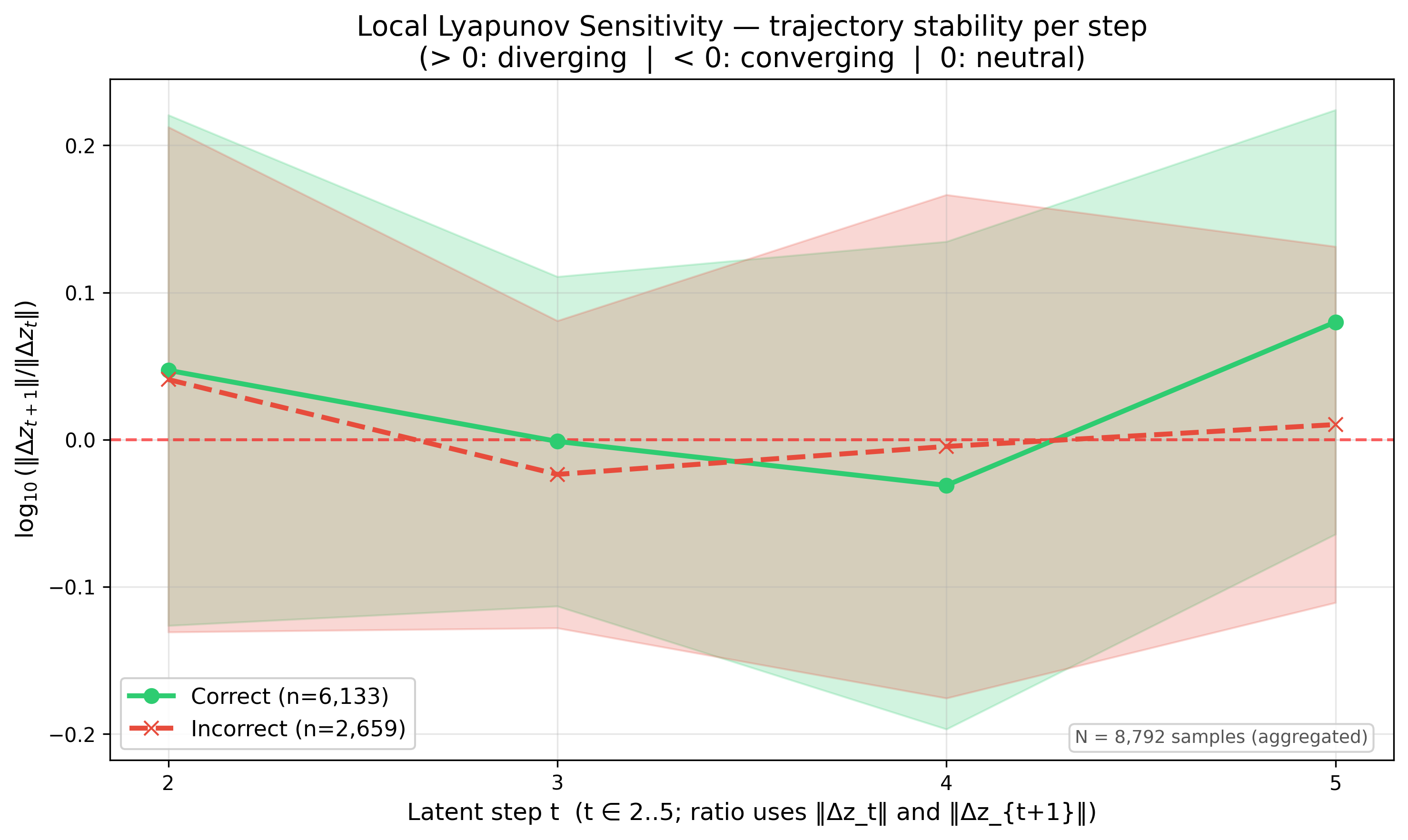
CODI shows a monotonically decreasing curve with negative values, indicating local convergence throughout. Sim-CoT deepens this convergence further. COCONUT shows a sharp positive spike at $t=3$ in Vanilla, a genuine mid-chain exploration phase native to its curriculum-trained dynamics. Sim-CoT removes this spike and flattens the curve, replacing exploration with a deterministic transition.

CODI
COCONUT
Vanilla
Lyapunov CODI Vanilla
Lyapunov COCONUT Vanilla
Sim-CoT
Lyapunov CODI SimCoT
Lyapunov COCONUT SimCoT

Direction Consistency

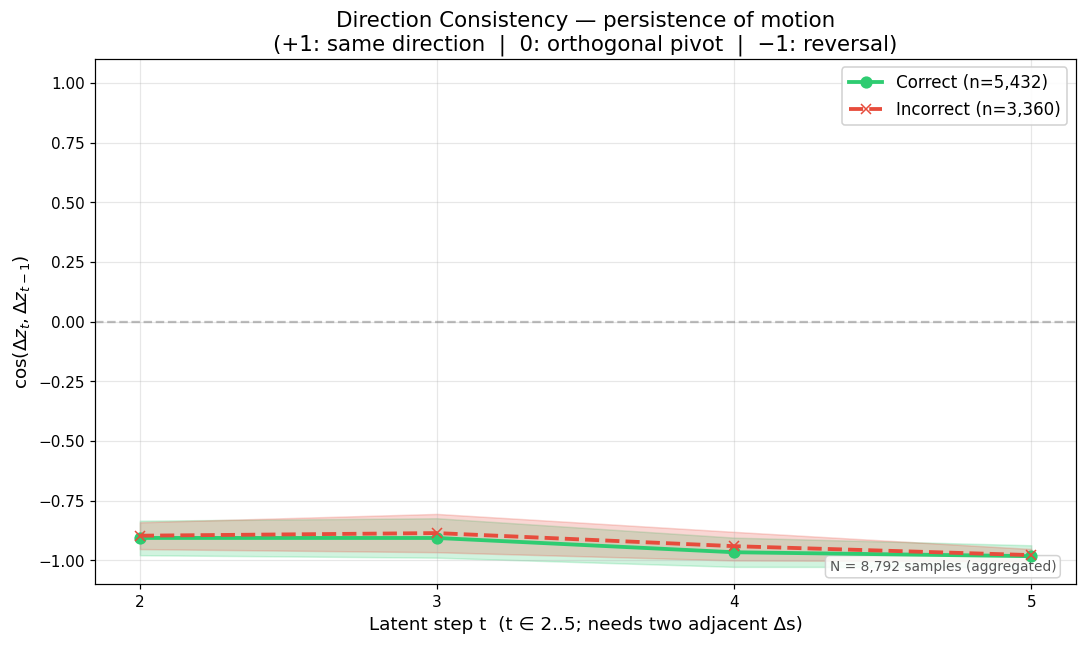
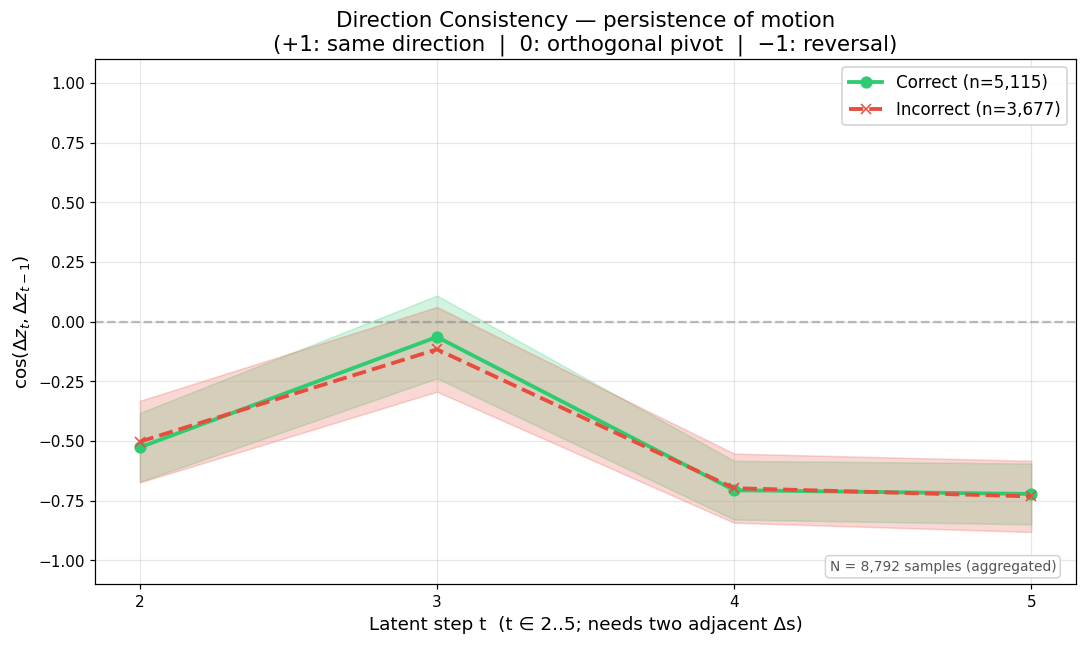
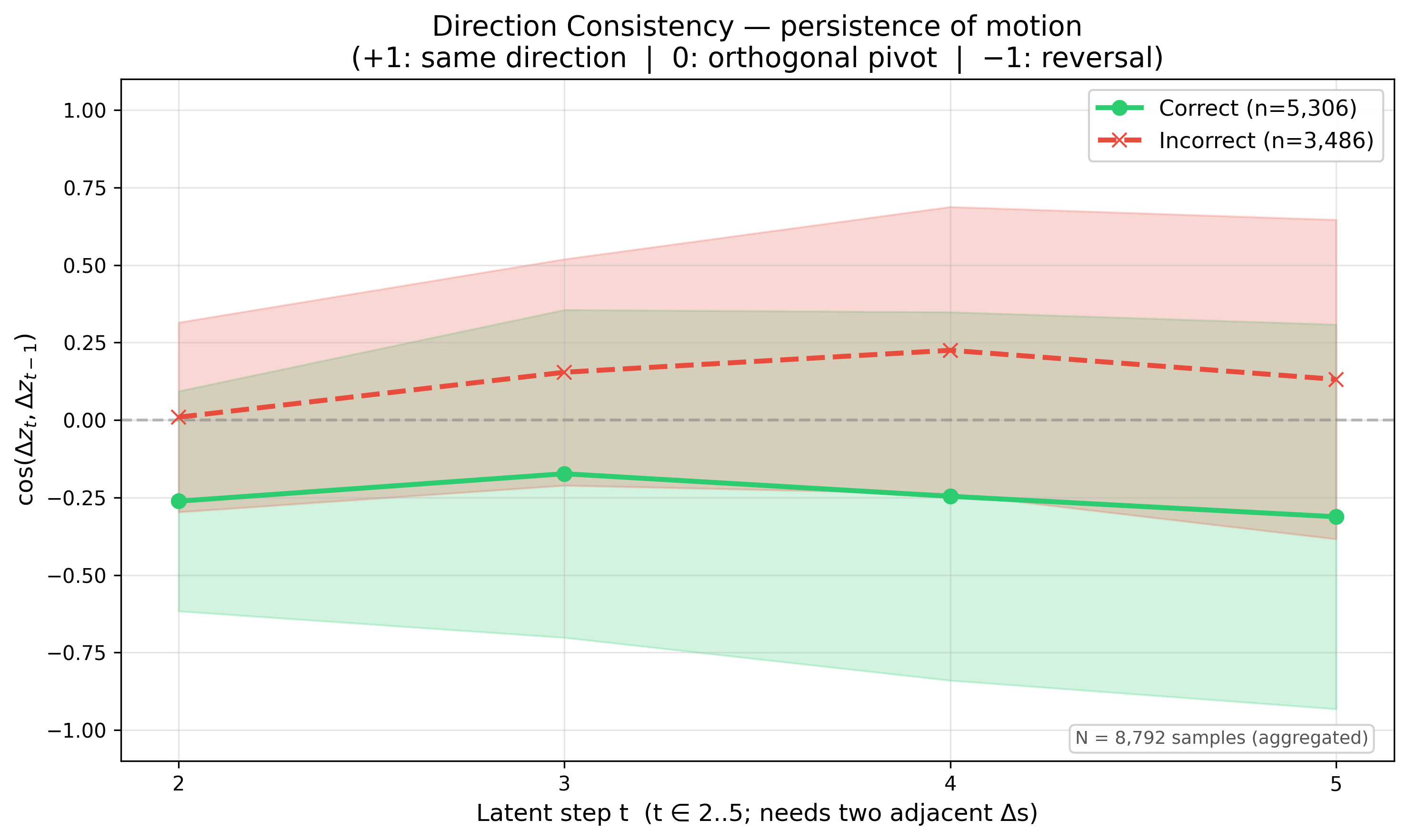
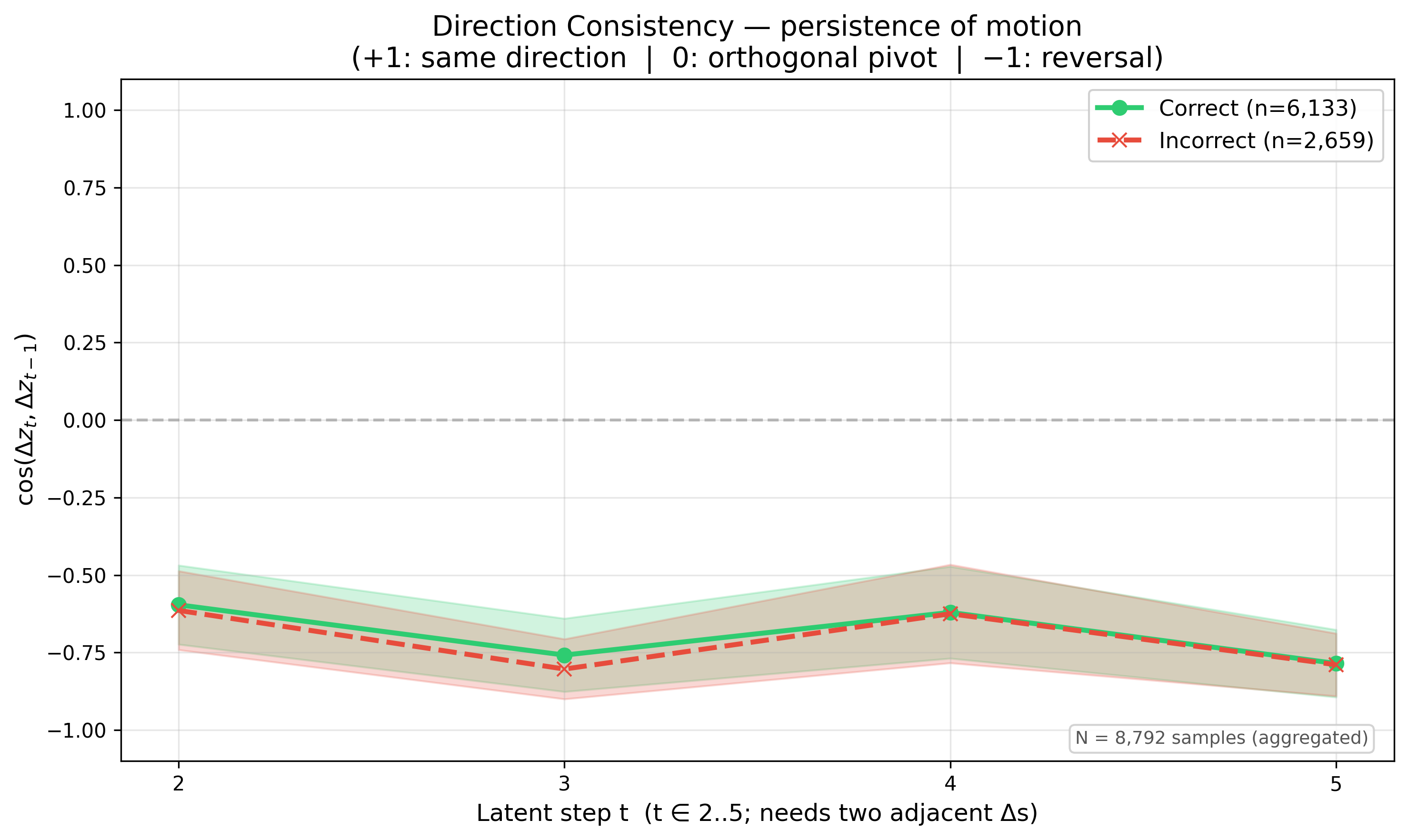
CODI Vanilla shows consistently negative values across all transitions. The trajectory reverses direction at every step. Sim-CoT shifts this toward near-zero, replacing reversals with orthogonal pivots. COCONUT Vanilla starts with opposing transitions, becomes near-orthogonal at $t=3$, then reverts. Sim-CoT stabilizes COCONUT into a single consistent opposing pattern. Neither paradigm produces the forward alignment expected of a directionally converging reasoner.

CODI
COCONUT
Vanilla
Direction CODI Vanilla
Direction COCONUT Vanilla
Sim-CoT
Direction CODI SimCoT
Direction COCONUT SimCoT

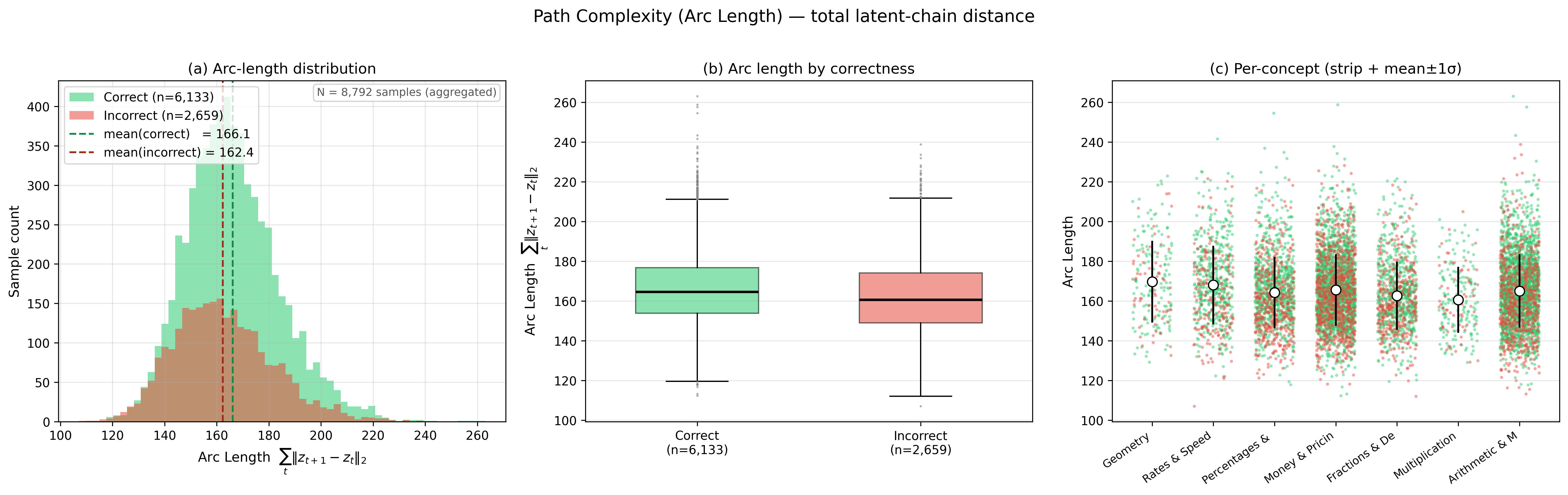
Arc Length

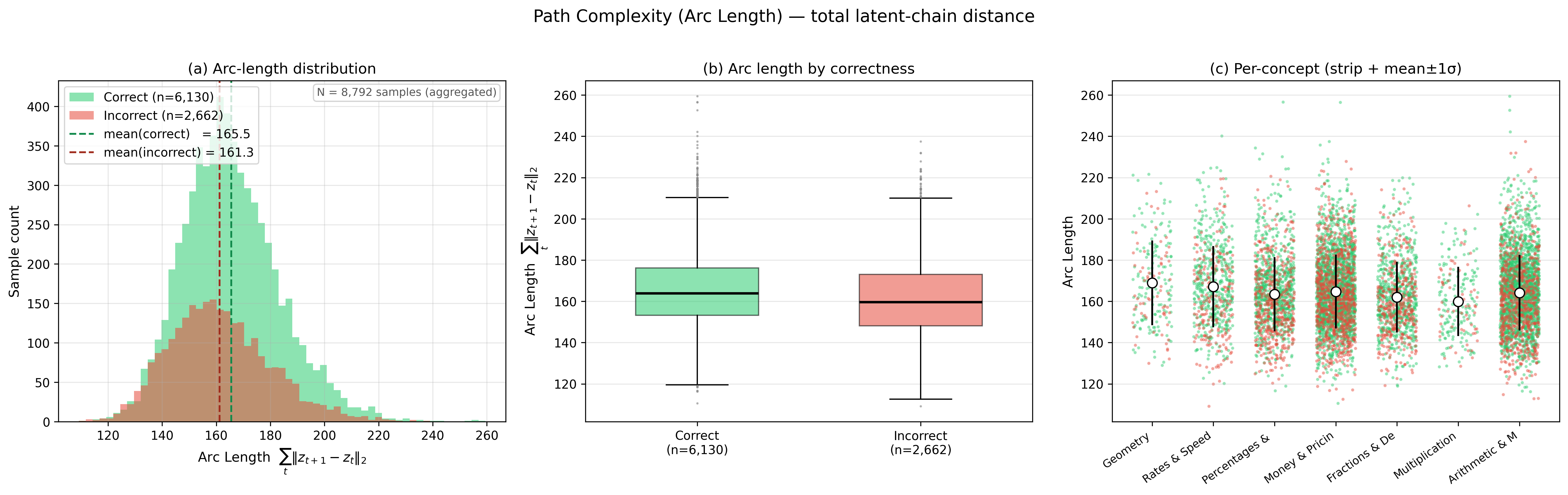
Arc length summarizes total trajectory displacement, reflecting overall reasoning effort. It captures how much latent space the model traverses from start to end of the reasoning chain.

Arc Length COCONUT Vanilla
COCONUT (Vanilla)
Arc Length CODI Vanilla
CODI (Vanilla)

Perturbation Stability

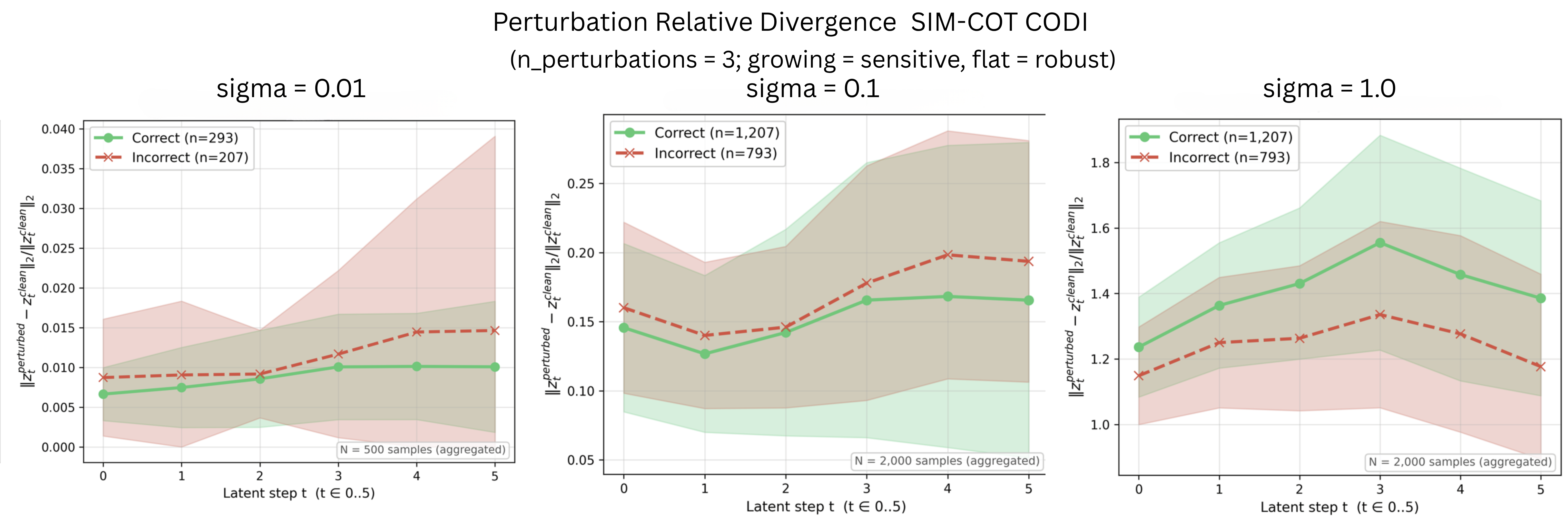
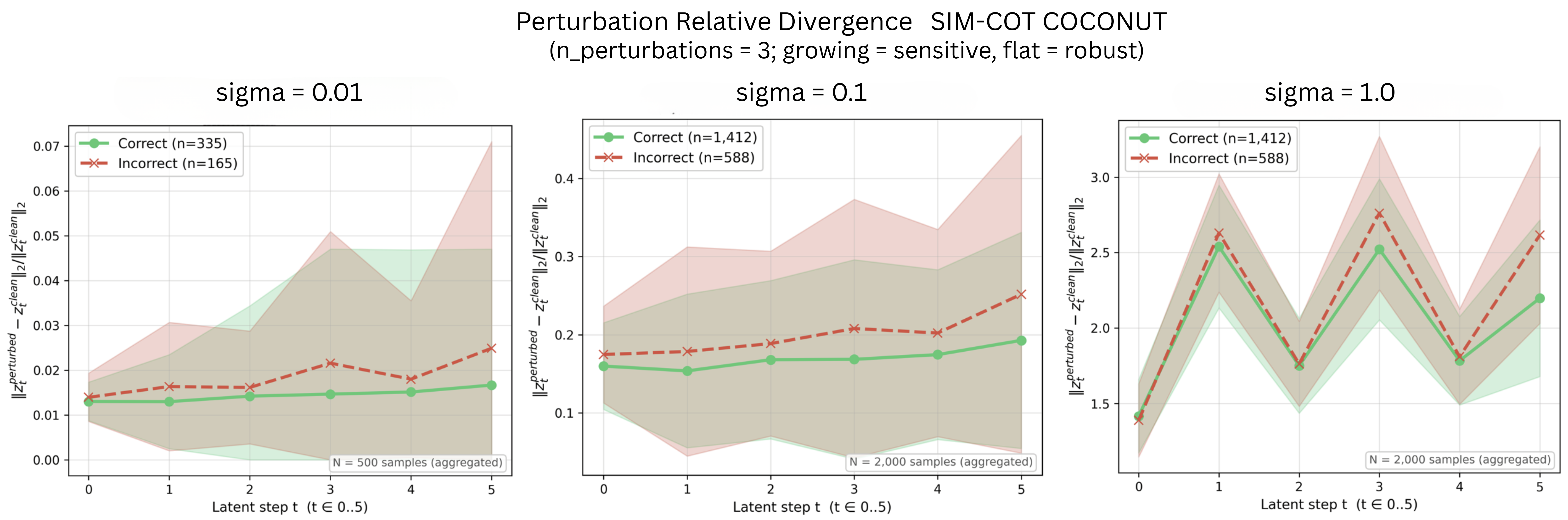
Perturbation stability measures trajectory divergence when Gaussian noise is injected into input embeddings, tested at $\sigma \in \{0.01, 0.1, 1.0\}$. Growing divergence indicates sensitivity to initial conditions. Incorrect predictions consistently diverge more than correct ones.

Perturbation CODI SimCoT
CODI (Sim-CoT): relative divergence at $\sigma \in \{0.01, 0.1, 1.0\}$.
Perturbation COCONUT SimCoT
COCONUT (Sim-CoT): relative divergence at $\sigma \in \{0.01, 0.1, 1.0\}$.

Qualitative Analysis

Trajectory projections reveal how each model organizes its reasoning manifold. CODI and COCONUT exhibit fundamentally different geometric signatures.

DMD Projections

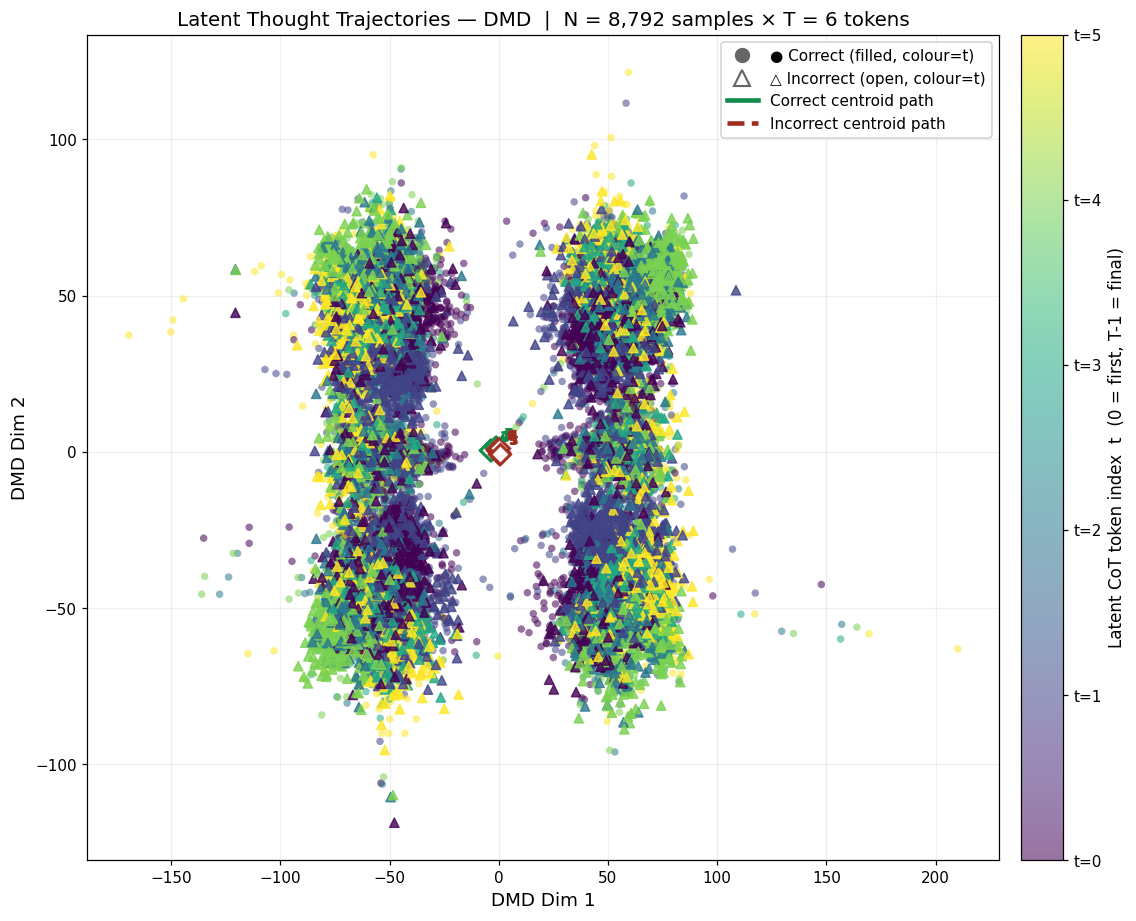
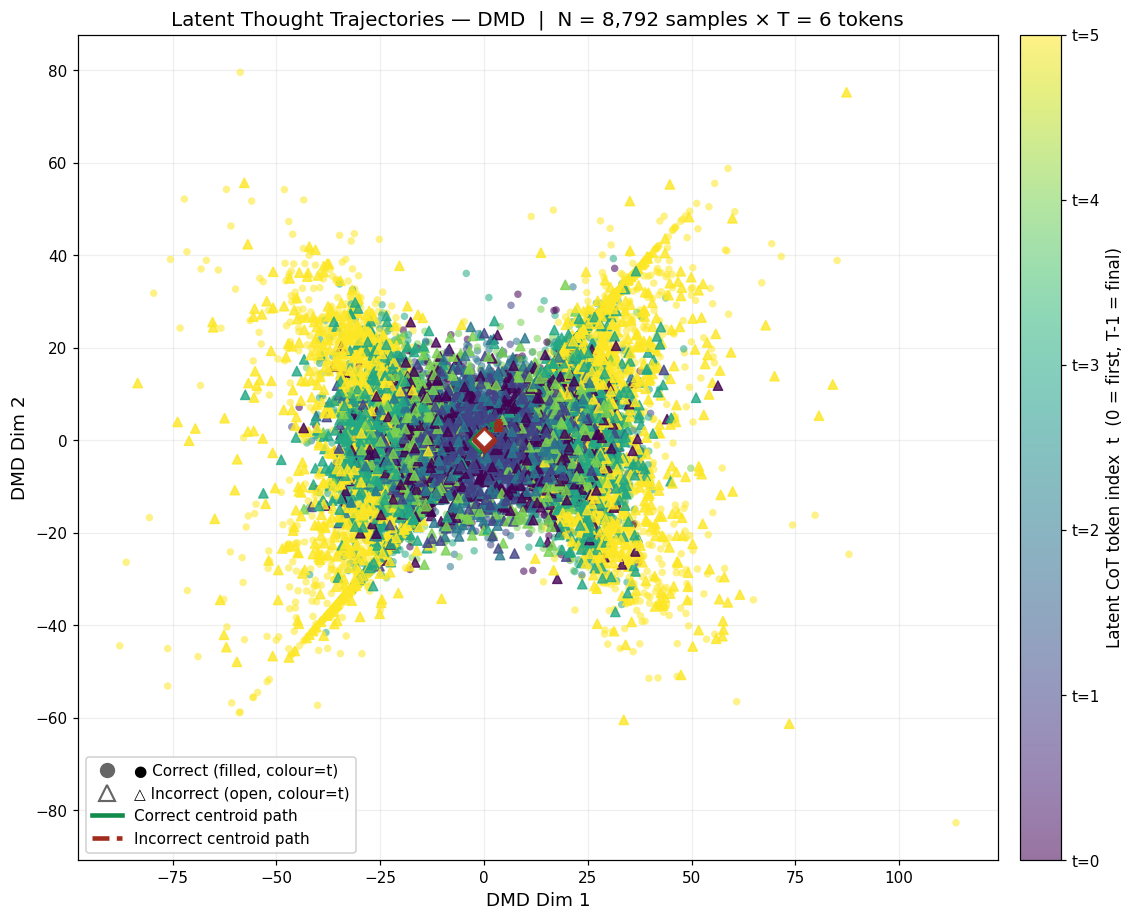
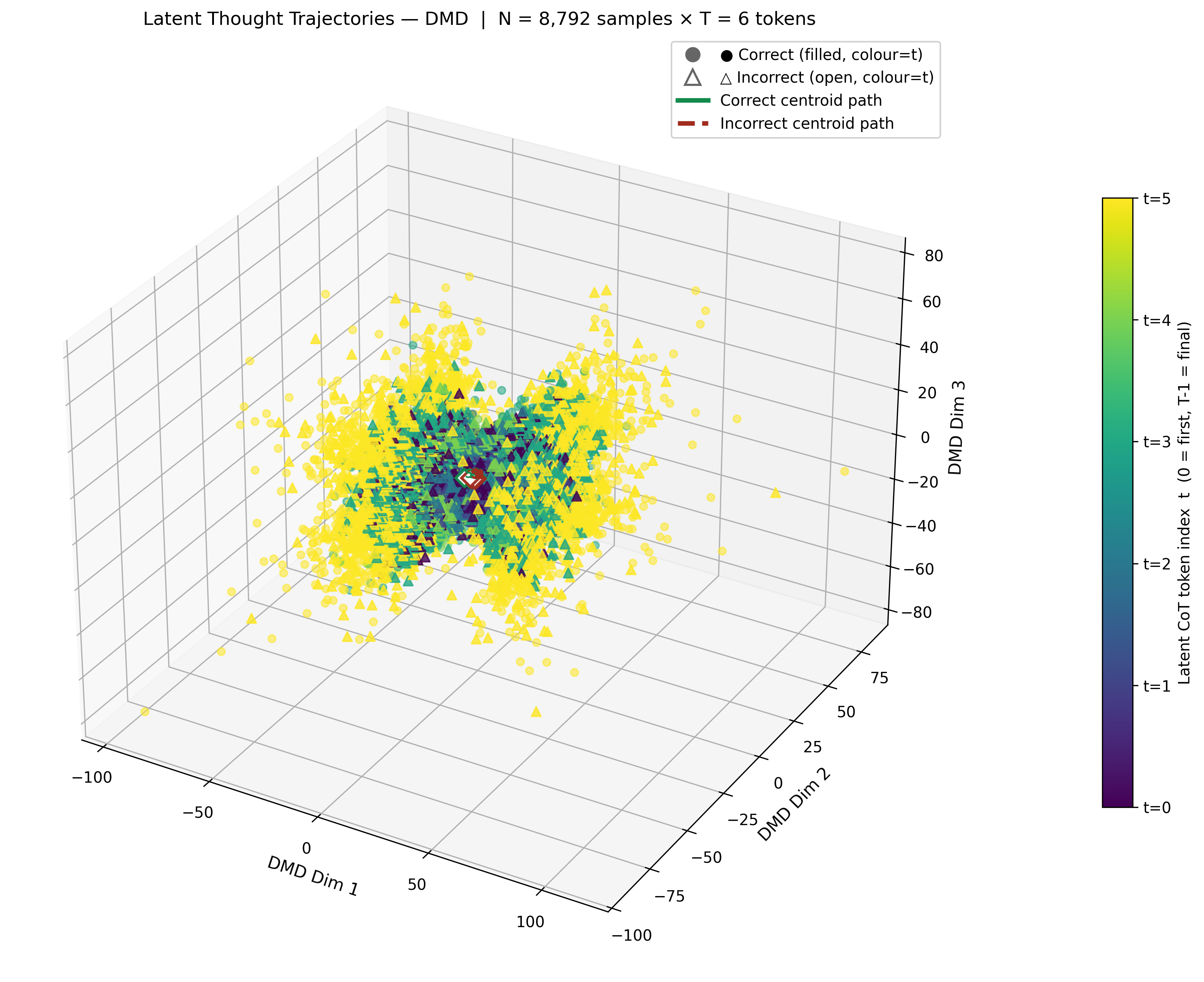
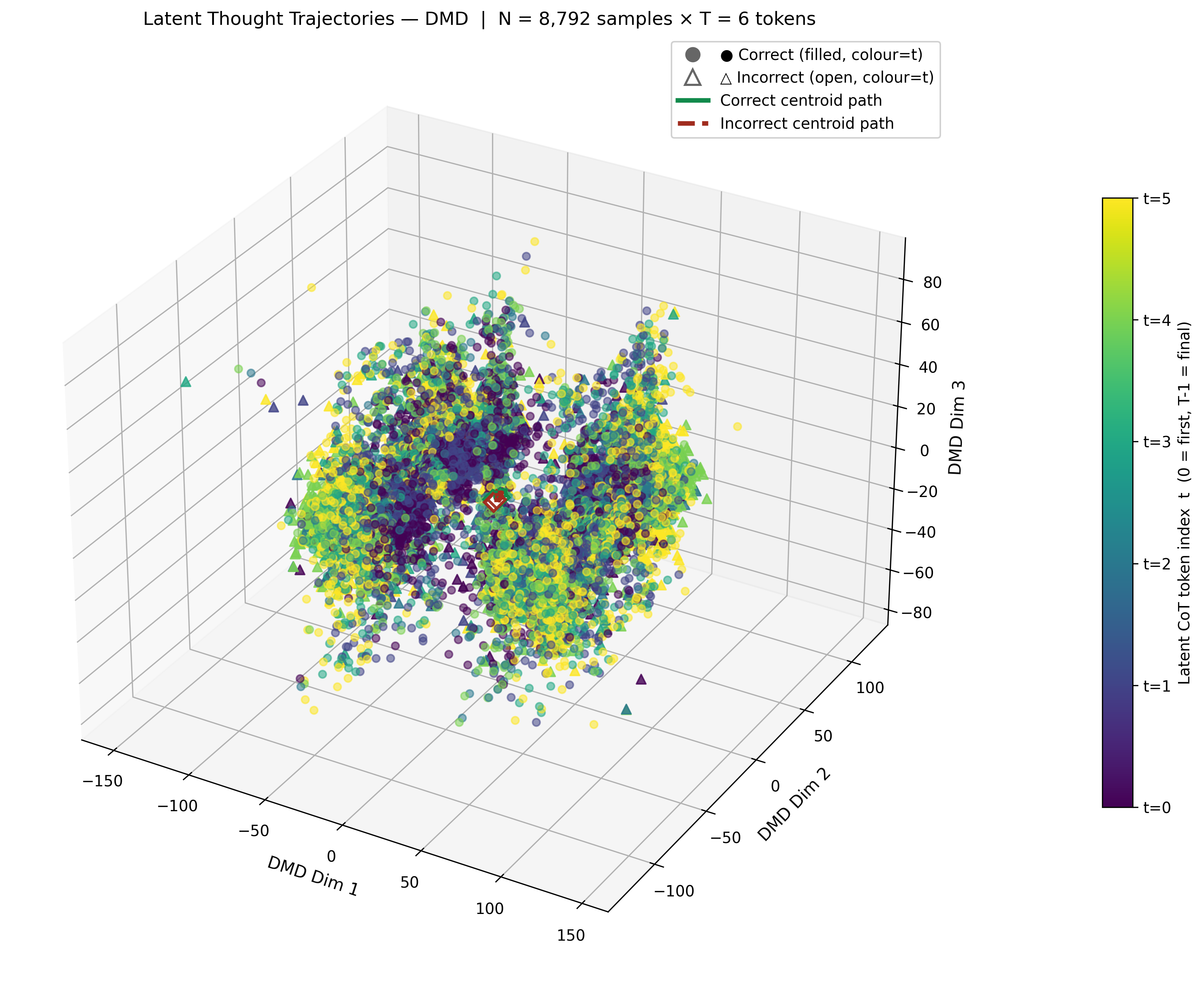
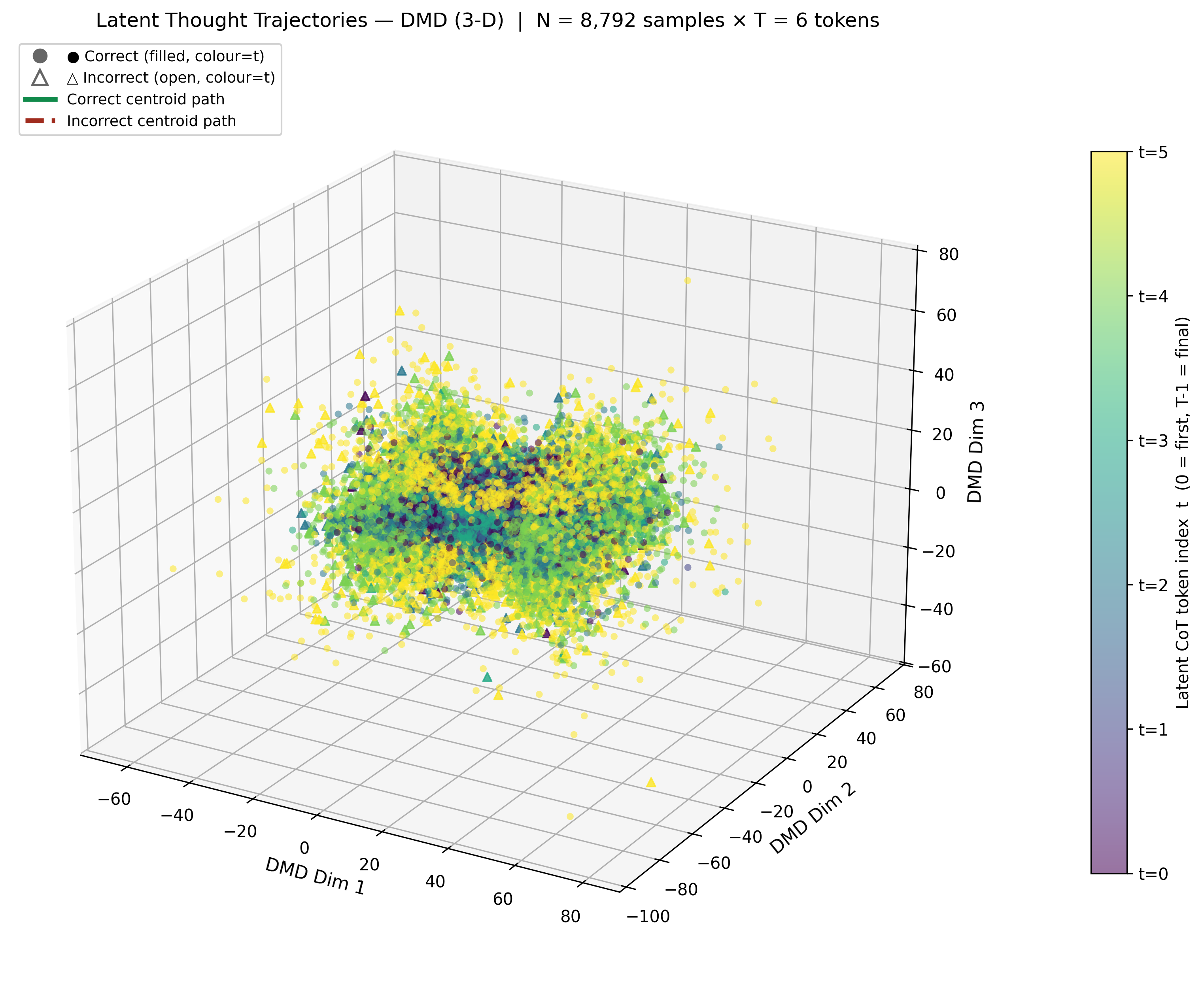
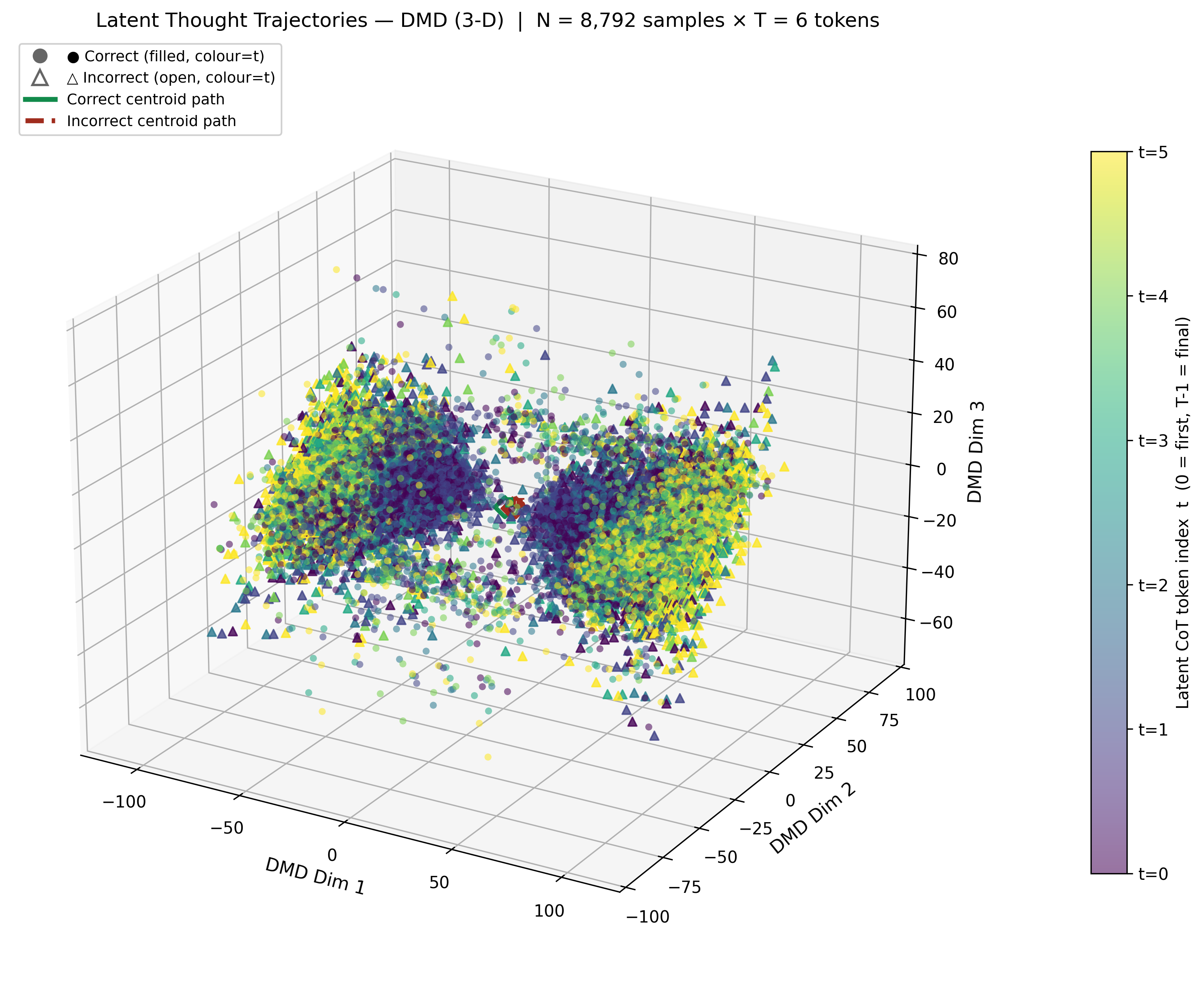
DMD projects each trajectory onto its dominant modes of variation. CODI shows a two-lobe pattern where all latent states remain tightly packed throughout the chain. This is the signature of a stable attractor. COCONUT shows a butterfly pattern where latent states start near the center at $t=0$ and spread outward by $t=5$. This reflects an expanding dynamical system exploring multiple reasoning paths simultaneously.

DMD - CODI Vanilla
CODI (Vanilla). Tightly packed two-lobe structure across all latent steps.
DMD - COCONUT Vanilla
COCONUT (Vanilla). Butterfly pattern with latent states diverging outward across steps.

PHATE Projections

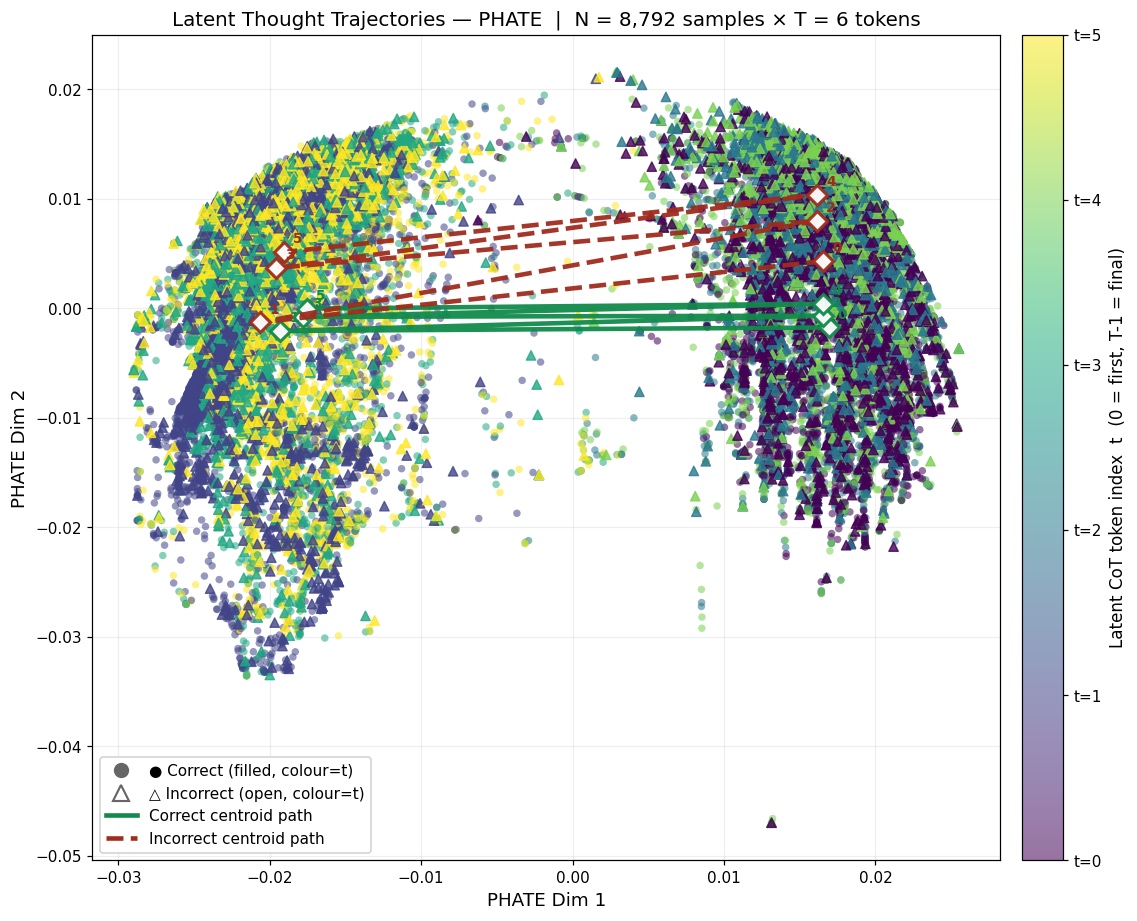
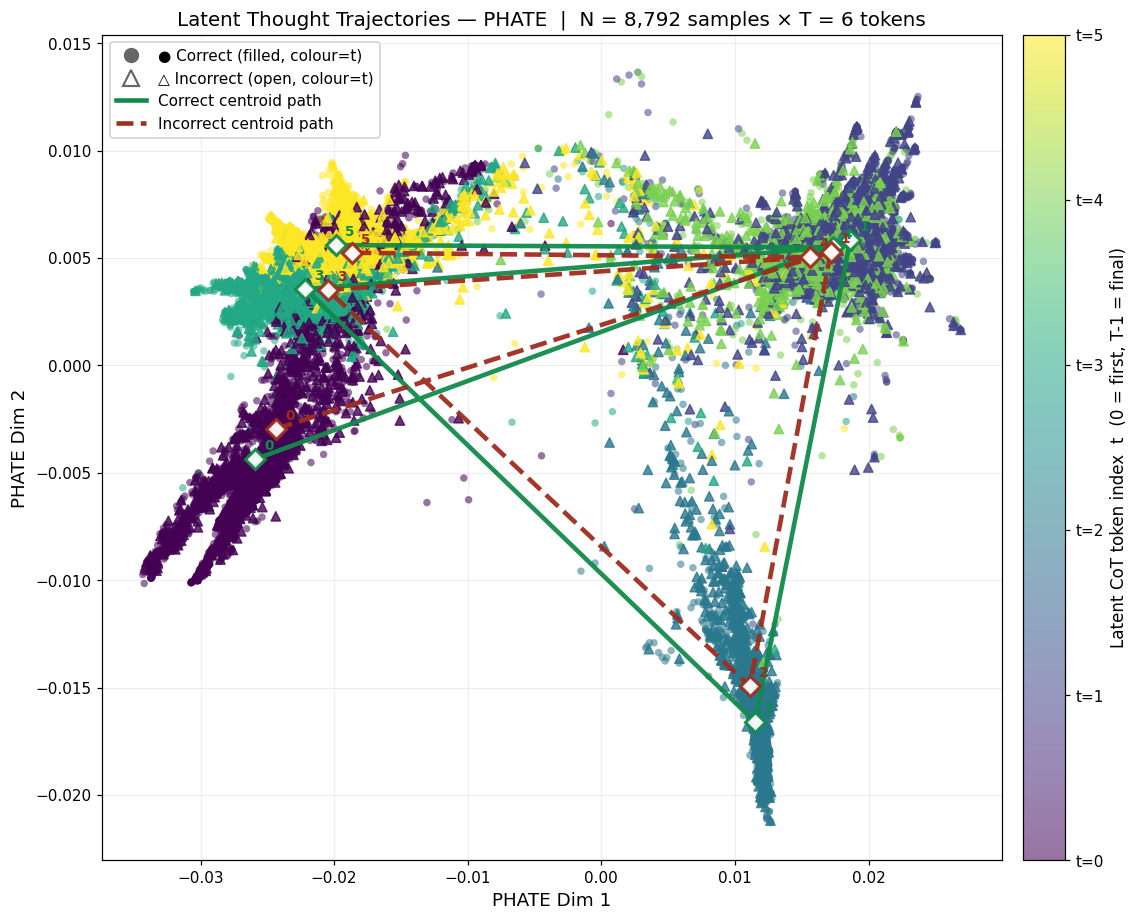
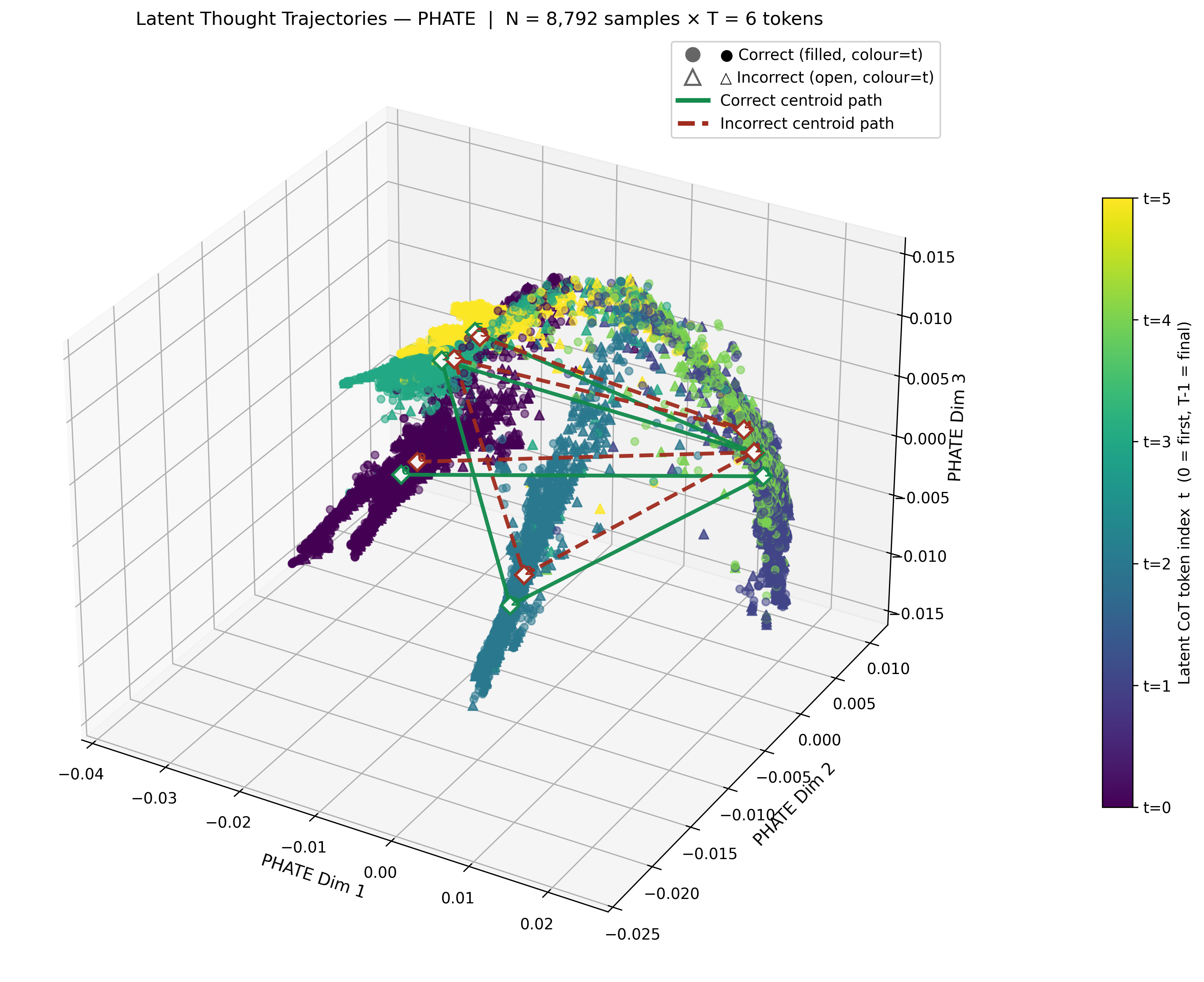
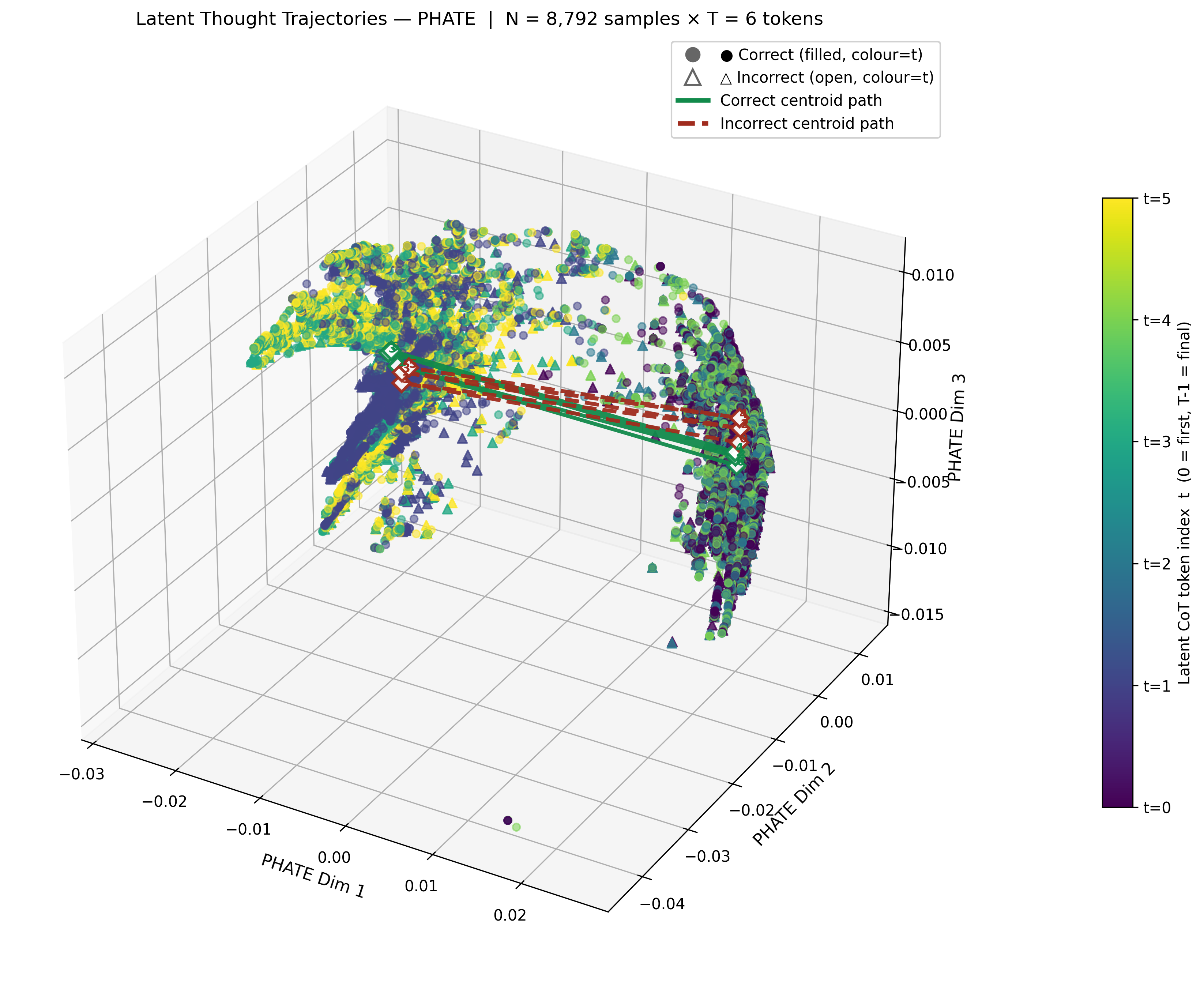
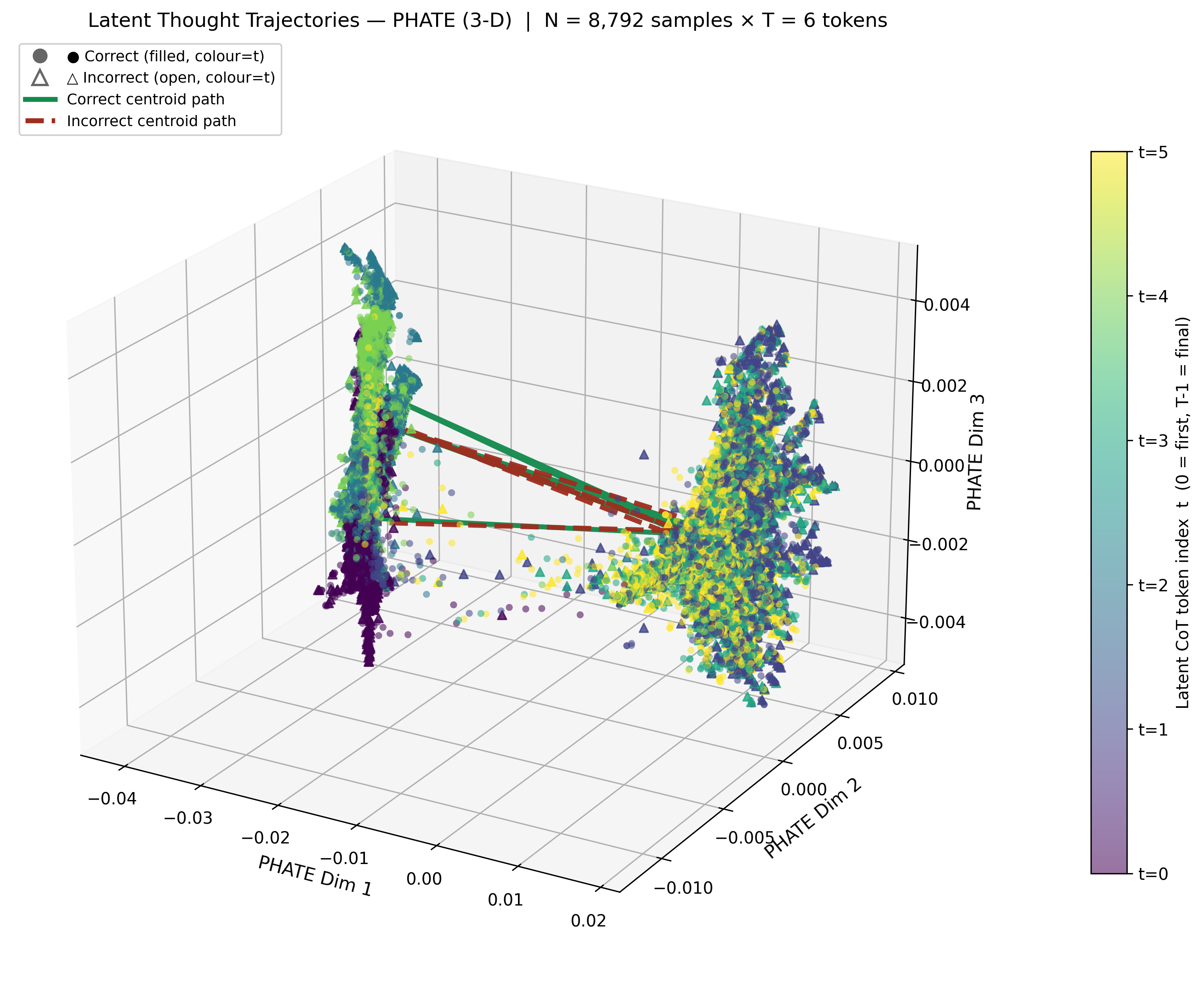
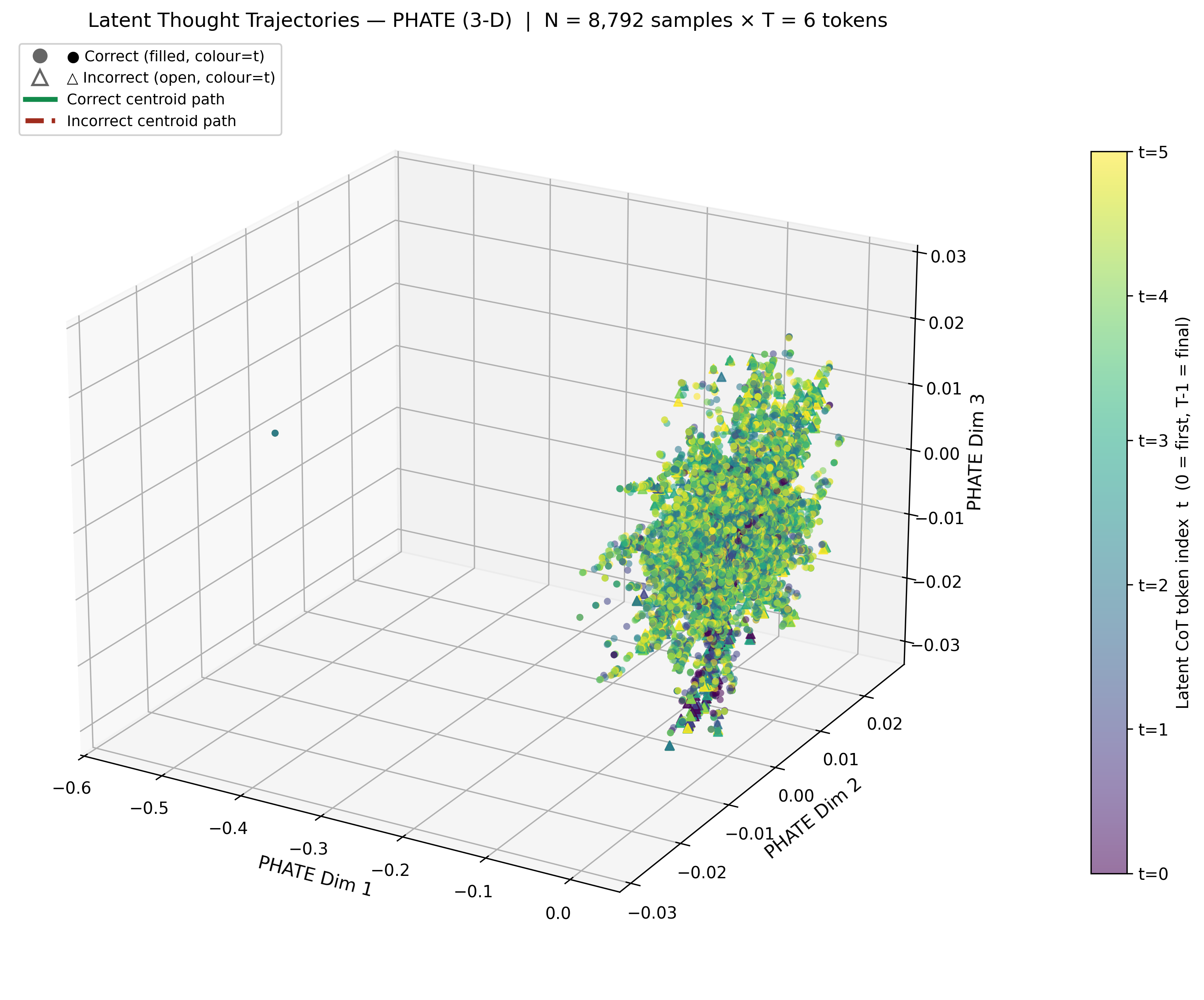
PHATE uses a multi-scale diffusion process to expose the global manifold structure. CODI shows compact, interleaved representations bounded throughout the chain. COCONUT shows each latent step occupying a distinct region, with beginning and end tokens positioned close together. This proximity hints at a possible shortcut pathway through the reasoning chain.

PHATE - CODI Vanilla
CODI (Vanilla). Interleaved representations with no shortcut signature.
PHATE - COCONUT Vanilla
COCONUT (Vanilla). Beginning and end tokens cluster close, hinting at shortcut pathways.

UMAP Projections

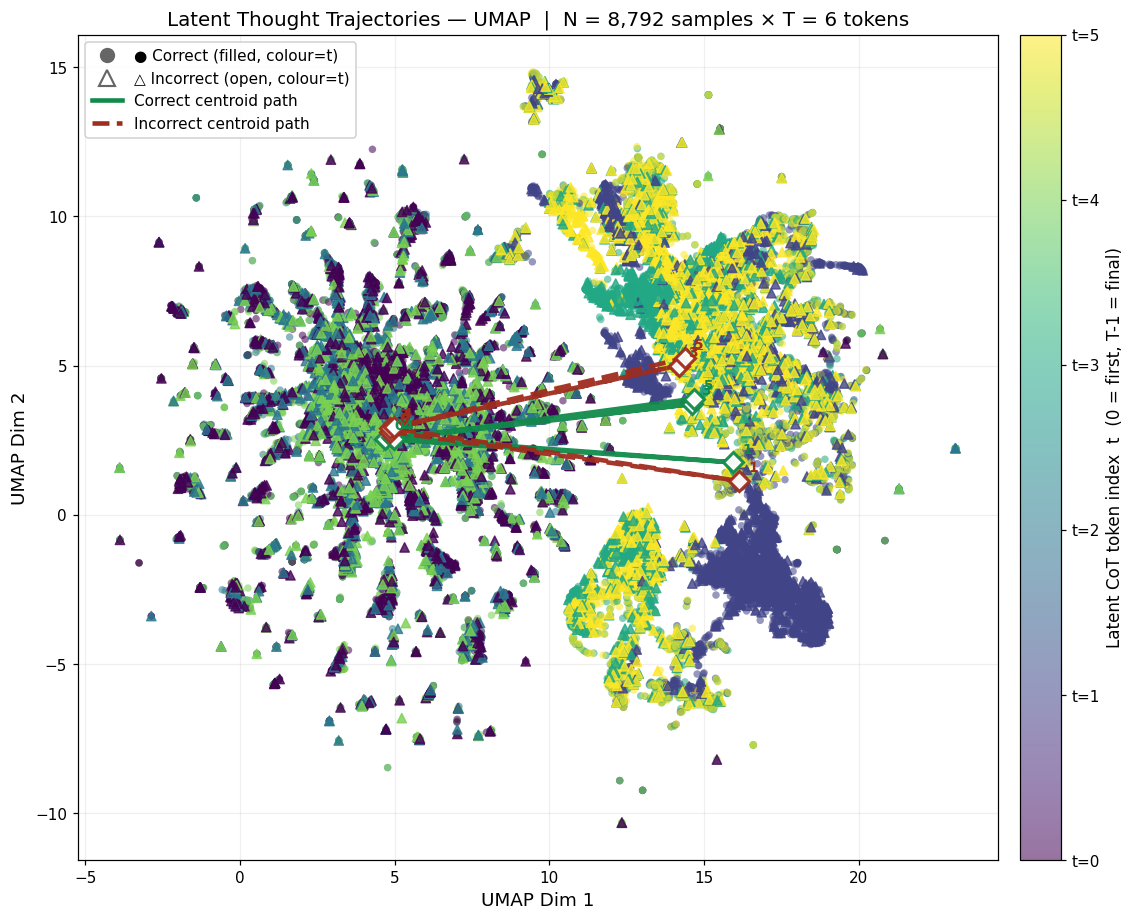
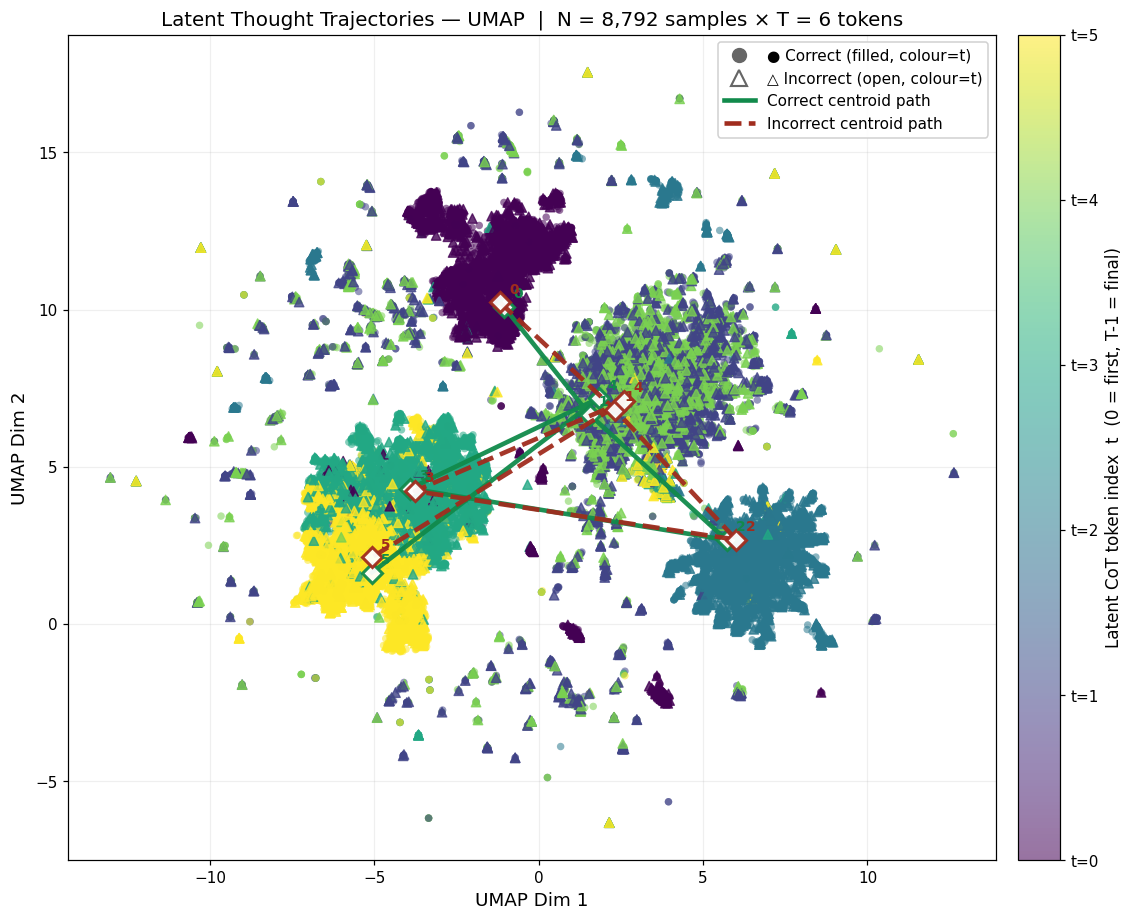
UMAP preserves local neighborhood relationships while balancing global structure. COCONUT separates each latent step into its own region, indicating distinct per-step reasoning roles. CODI groups tokens into two role-based clusters: mid-chain tokens spread broadly, while beginning and end tokens remain densely contained.
UMAP - CODI Vanilla
CODI (Vanilla). Two clusters: mid-chain tokens diffused, terminal tokens densely contained.
UMAP - COCONUT Vanilla
COCONUT (Vanilla). Each latent step occupies a distinct region, reinforcing step-specific roles.
Additional Trajectory Projections

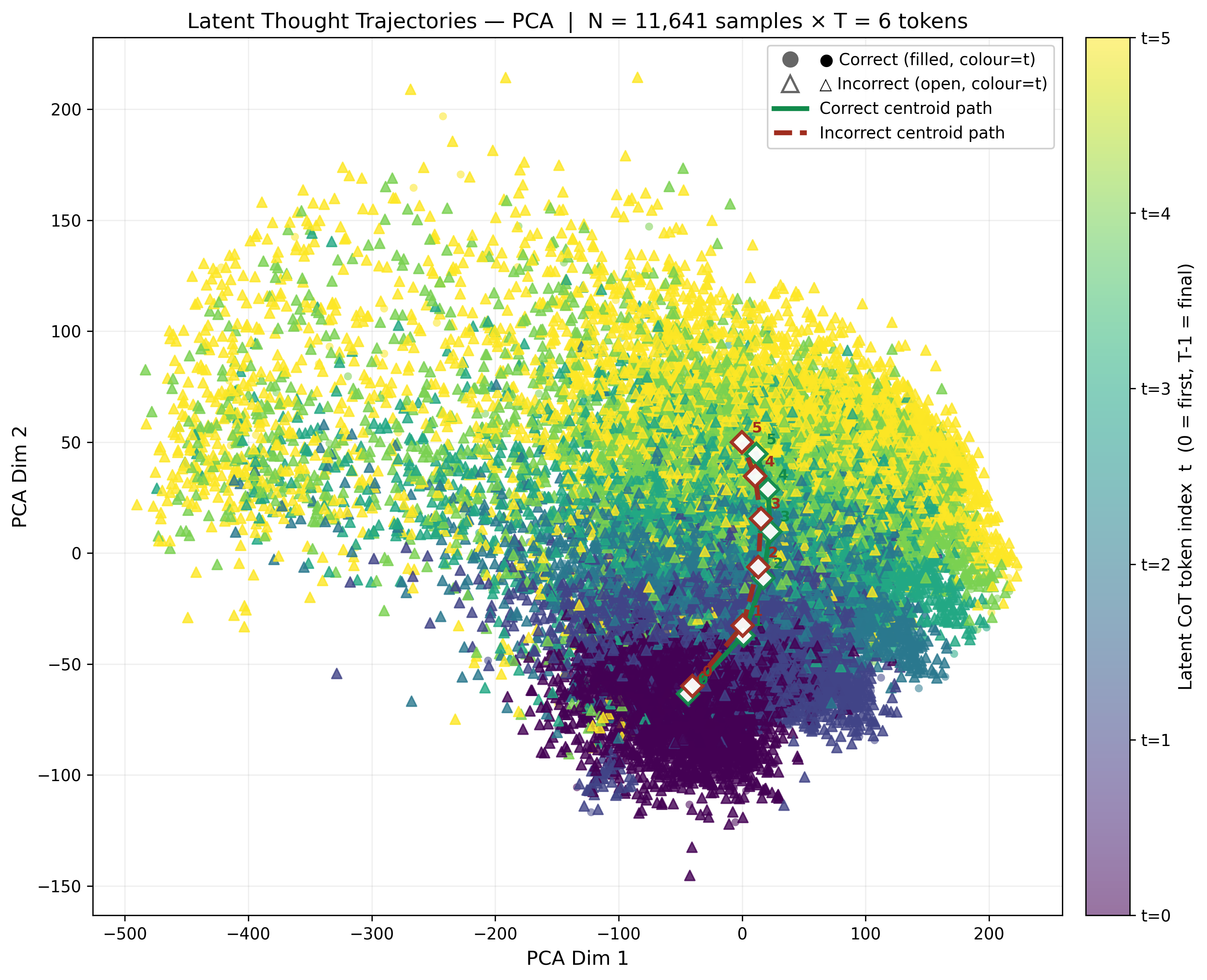
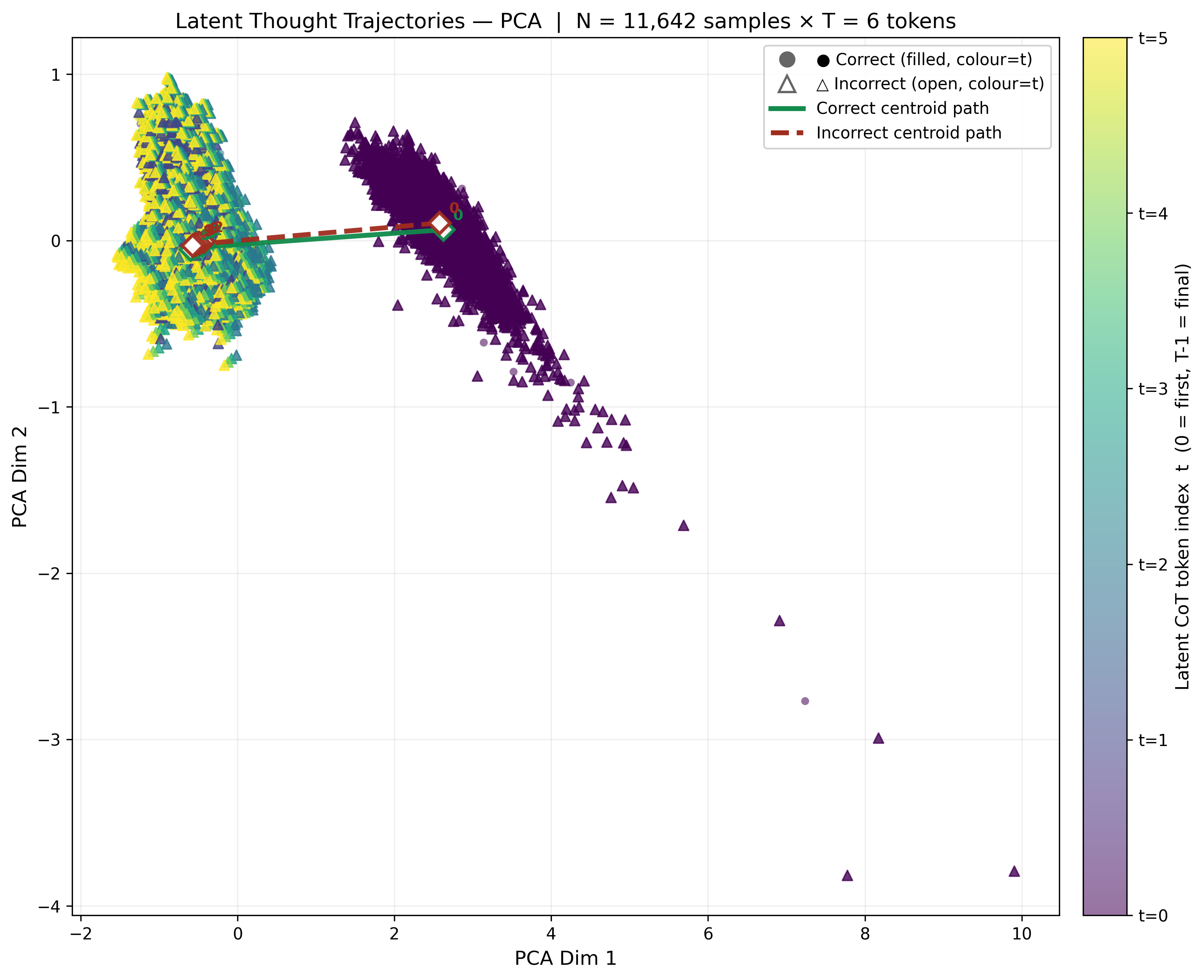
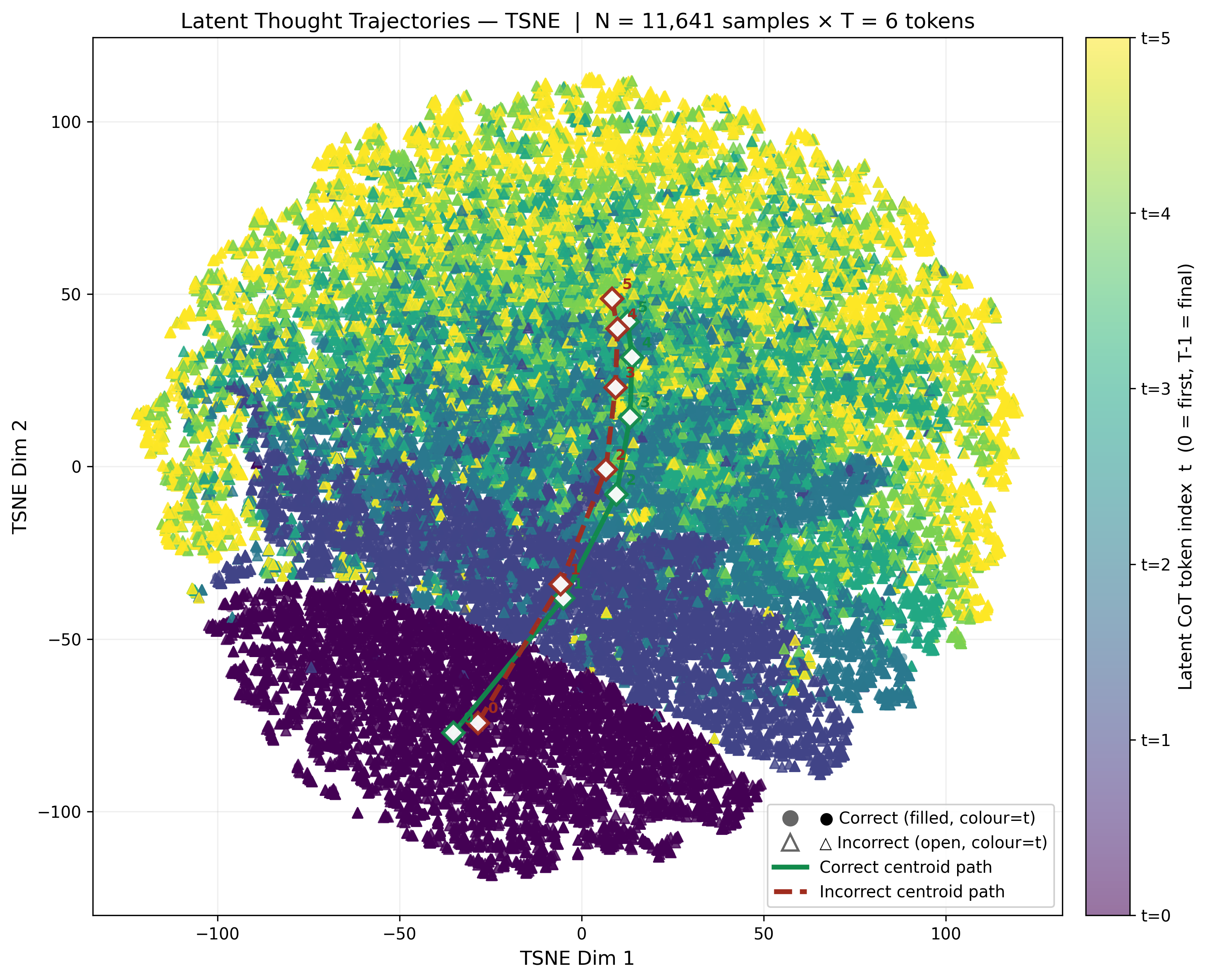
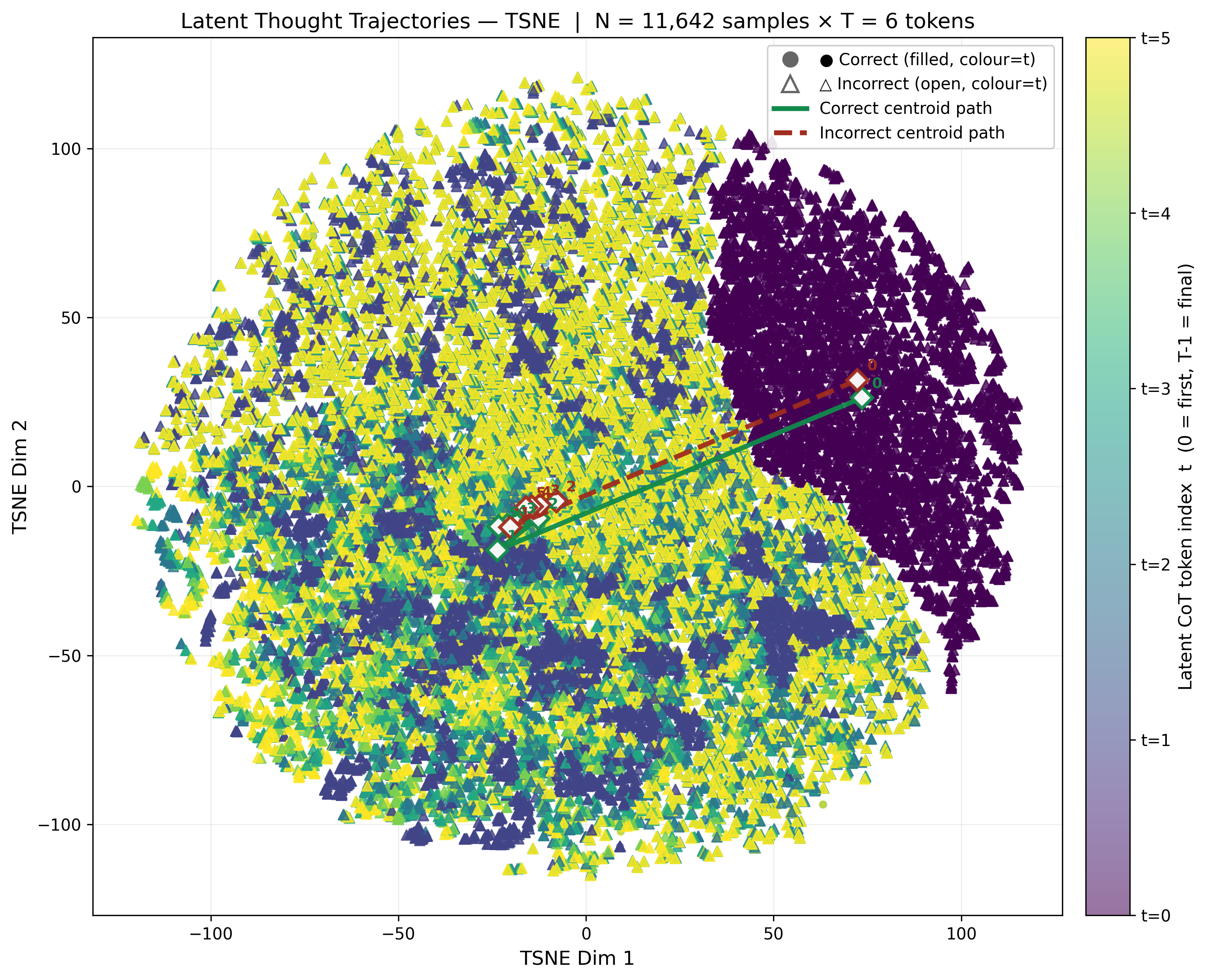
PCA and t-SNE Projections, and 3D DMD and PHATE Trajectory Visualizations for the Vanilla CoT Setting.

PCA COCONUT
COCONUT – PCA projection.
PCA CODI
CODI – PCA projection.
t-SNE COCONUT
COCONUT – t-SNE projection.
t-SNE CODI
CODI – t-SNE projection.

3D trajectory plots for DMD and PHATE projections across all four model configurations. The same geometric signatures seen in 2D are preserved in three dimensions.

DMD 3D

3D DMD COCONUT Vanilla
COCONUT (Vanilla)
3D DMD CODI Vanilla
CODI (Vanilla)

PHATE 3D

3D PHATE COCONUT Vanilla
COCONUT (Vanilla)
3D PHATE CODI Vanilla
CODI (Vanilla)

Supplementary Material

Additional figures from the paper appendix.

S.1. 3D Sim-CoT Trajectories

3D DMD and PHATE trajectory projections across latent steps for the Sim-CoT training setting, for both CODI and COCONUT.

DMD 3D (Sim-CoT)

3D DMD COCONUT SimCoT
COCONUT (Sim-CoT)
3D DMD CODI SimCoT
CODI (Sim-CoT)

PHATE 3D (Sim-CoT)

3D PHATE COCONUT SimCoT
COCONUT (Sim-CoT)
3D PHATE CODI SimCoT
CODI (Sim-CoT)

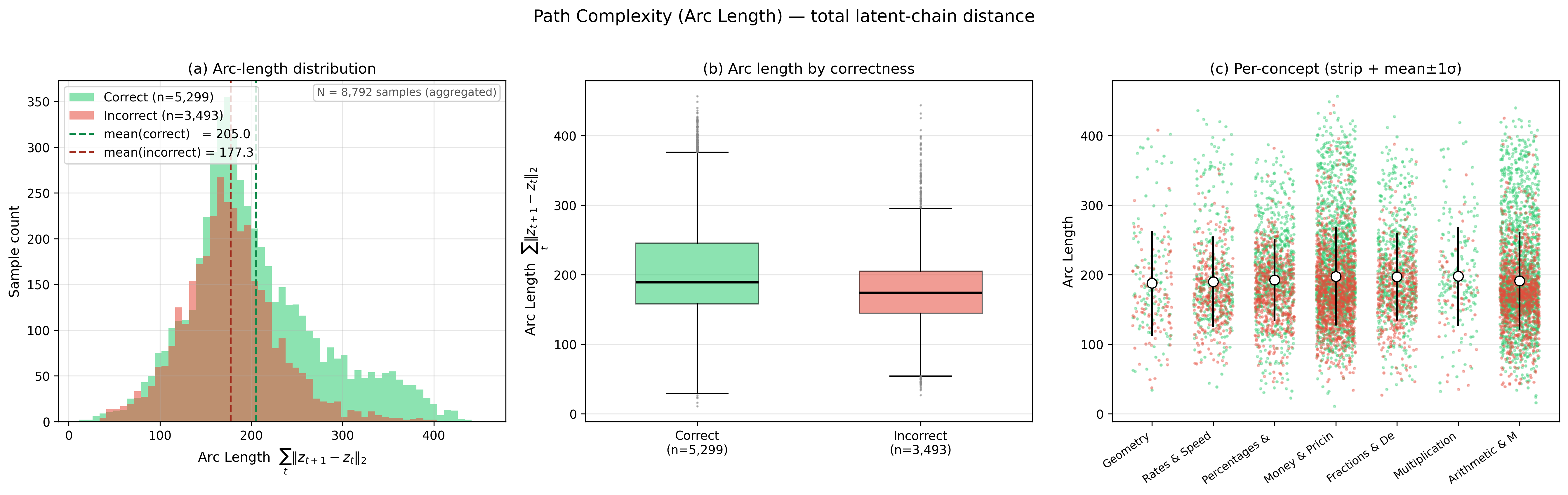
S.2. Arc Length (Sim-CoT)

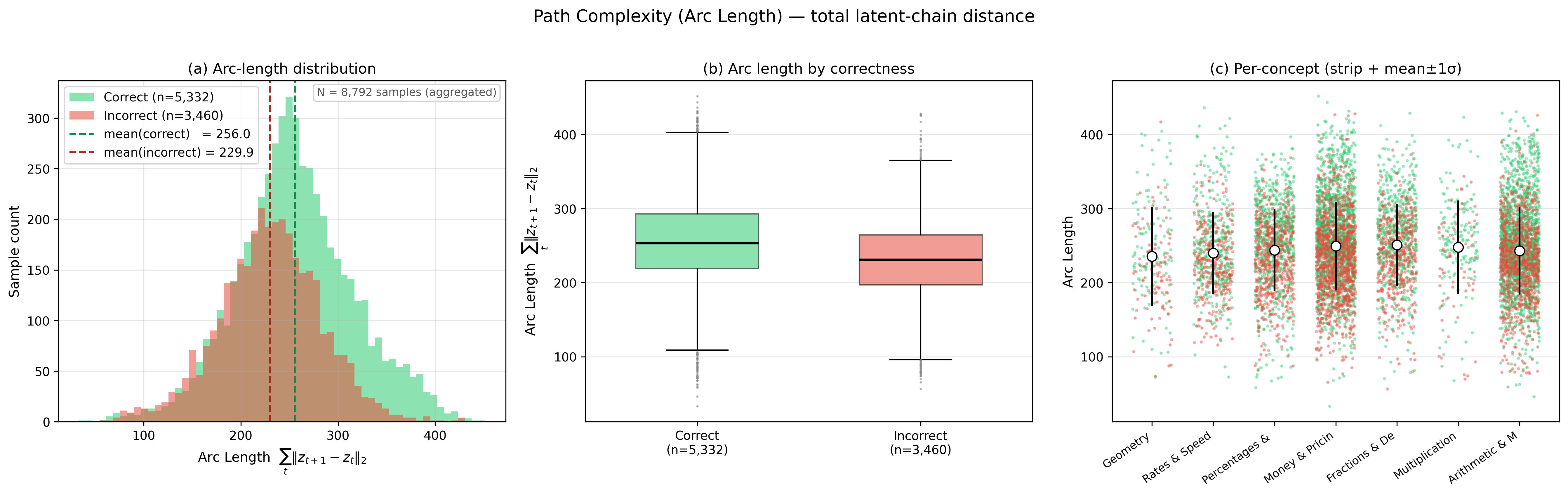
Arc length distributions for the Sim-CoT setting on GSM8K ($N = 8{,}792$), showing total trajectory displacement for each model.

Arc Length COCONUT SimCoT
COCONUT (Sim-CoT) arc length distribution.
Arc Length CODI SimCoT
CODI (Sim-CoT) arc length distribution.

S.3. Concept-wise Metrics

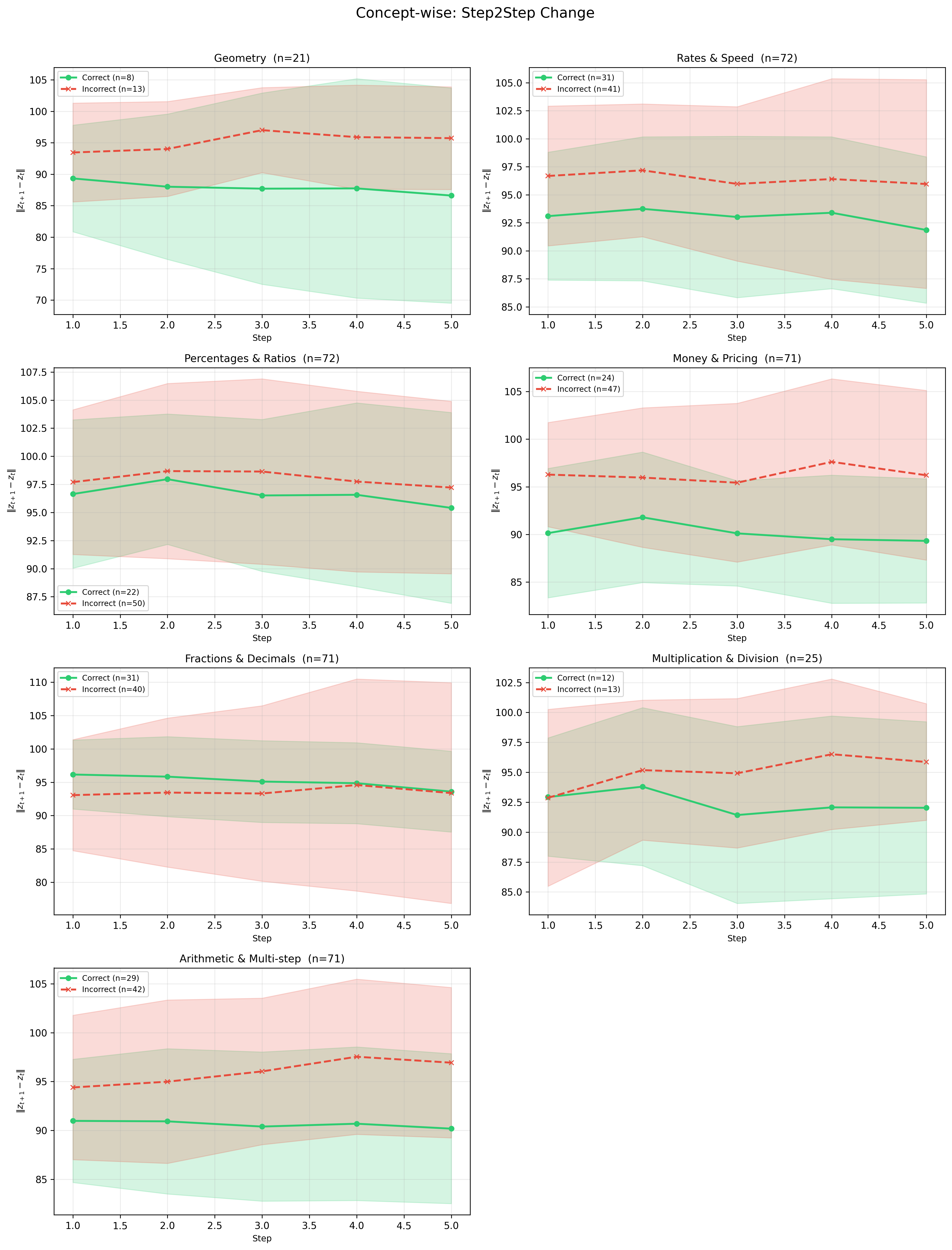
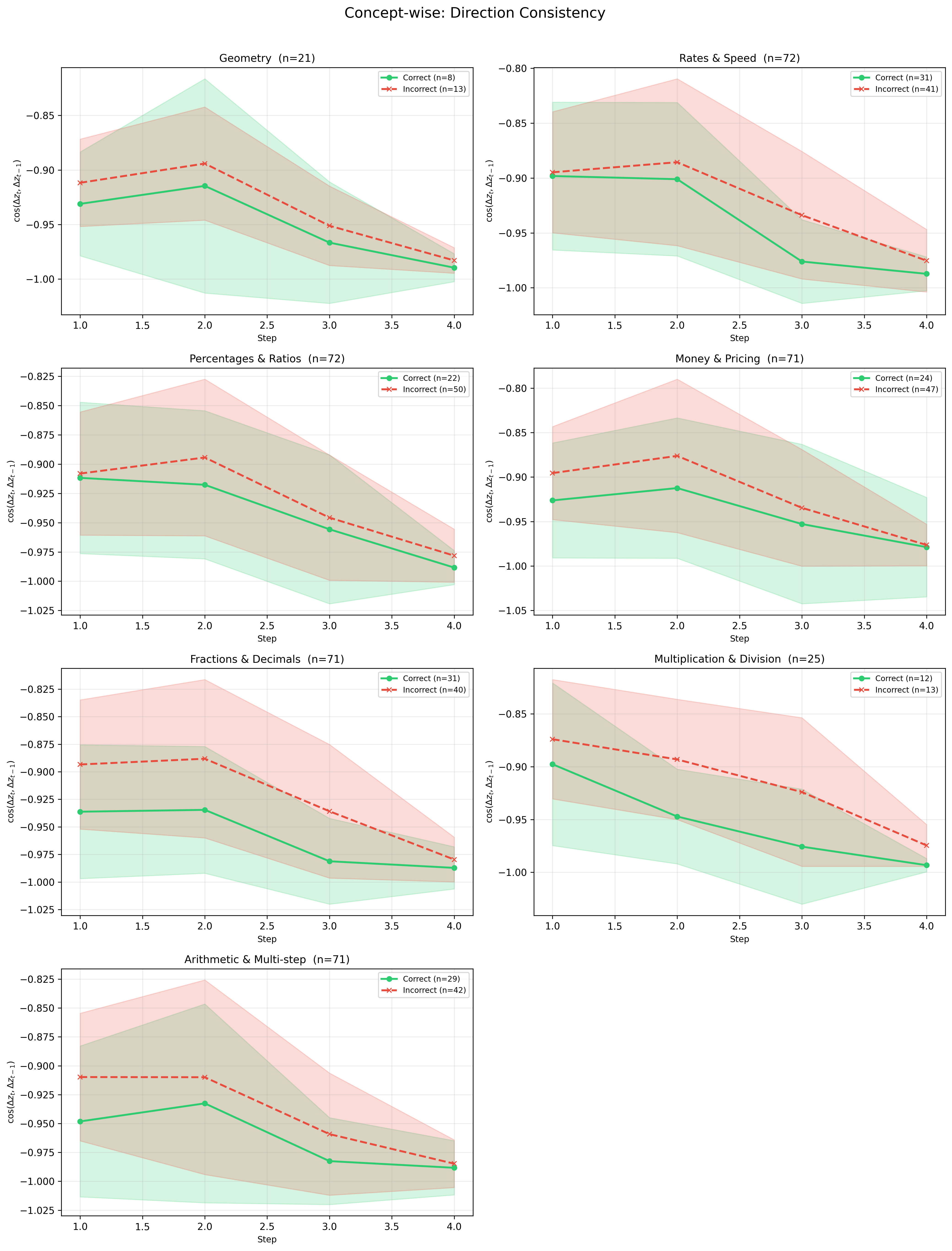
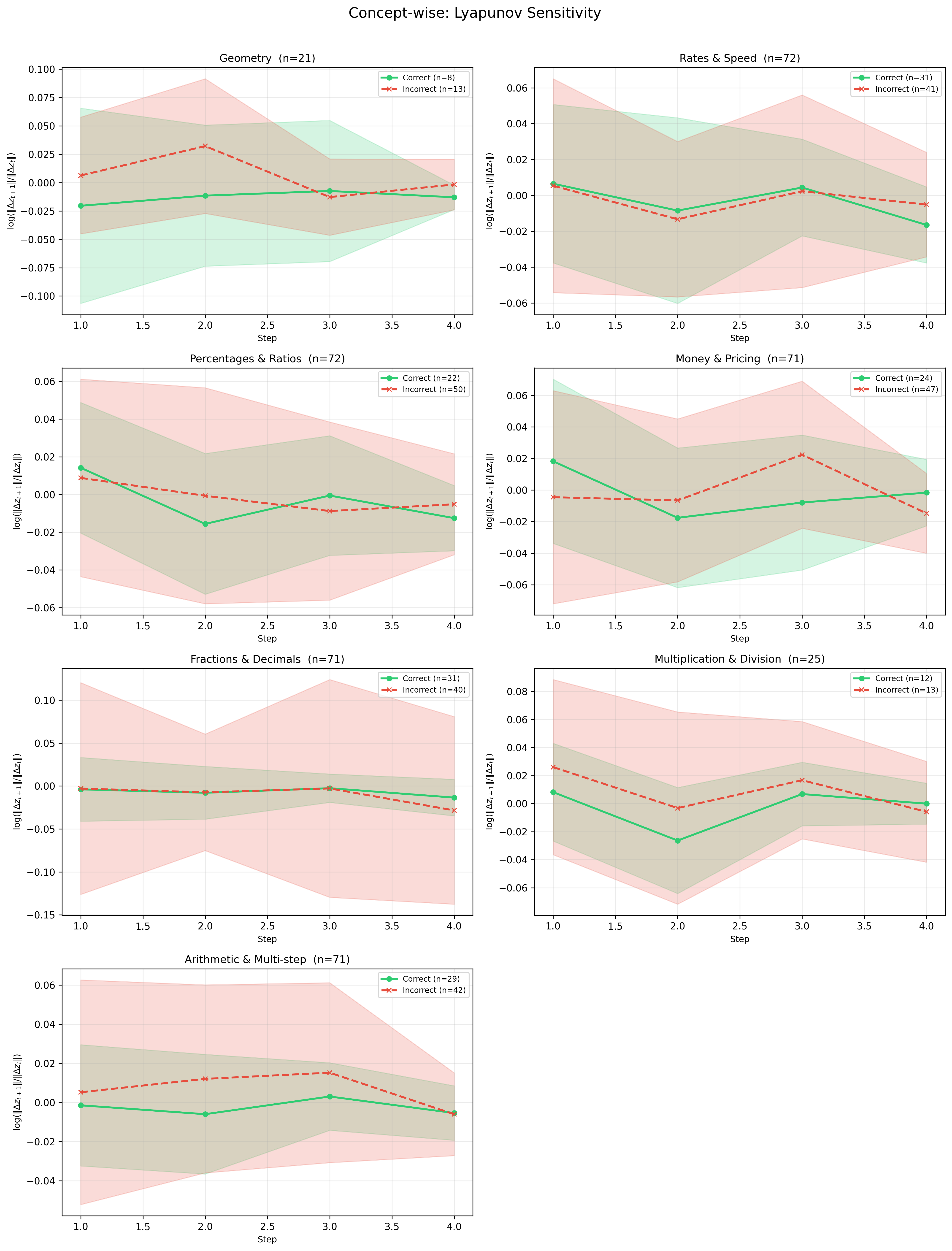
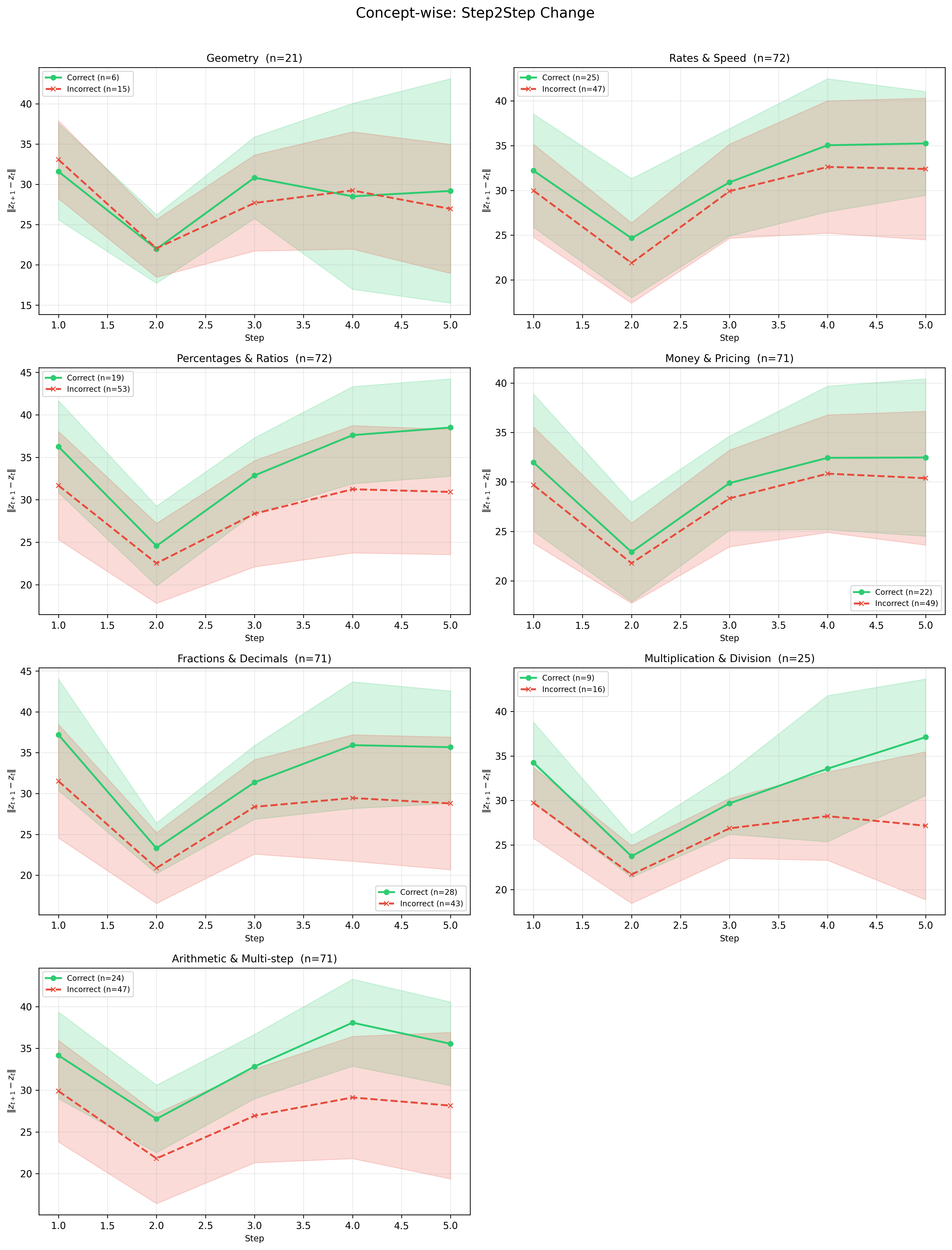
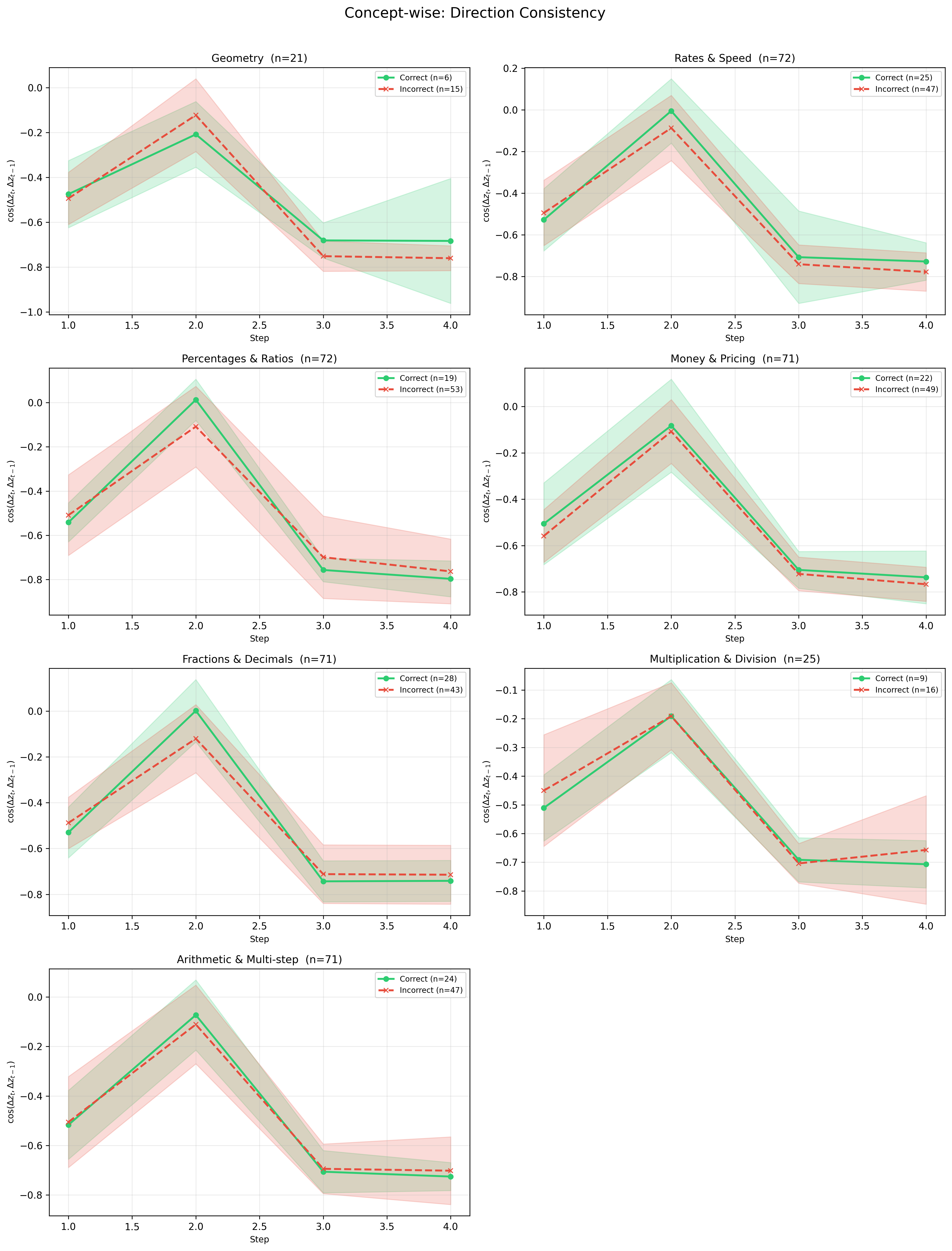
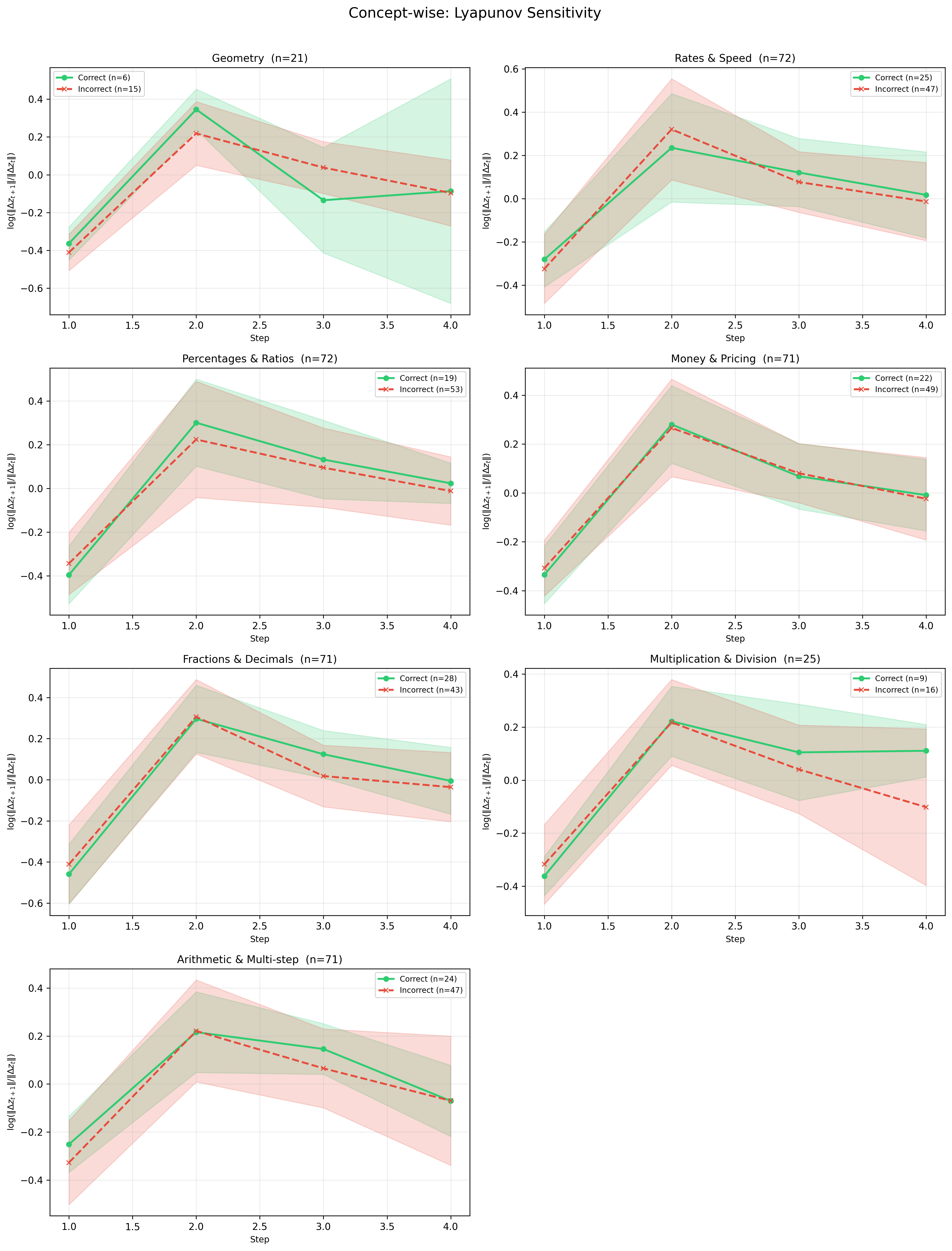
Metrics broken down by the seven GSM8K math concept categories: Geometry, Rates & Speed, Percentages & Ratios, Money & Pricing, Fractions & Decimals, Multiplication & Division, and Arithmetic & Multi-step.

Step-to-Step Change

COCONUT Concept Step2Step
COCONUT step-to-step change across GSM8K concept categories.

Direction Consistency

COCONUT Concept Direction
COCONUT direction consistency across GSM8K concept categories.

Lyapunov Sensitivity

COCONUT Concept Lyapunov
COCONUT Lyapunov sensitivity across GSM8K concept categories.

Step-to-Step Change

CODI Concept Step2Step
CODI step-to-step change across GSM8K concept categories.

Direction Consistency

CODI Concept Direction
CODI direction consistency across GSM8K concept categories.

Lyapunov Sensitivity

CODI Concept Lyapunov
CODI Lyapunov sensitivity across GSM8K concept categories.

Citation (BibTeX)

@inproceedings{latentcot-dynamical-systems-2026,
  title     = {Interpreting Latent {CoT} Reasoning as Dynamical Systems},
  author    = {Duraipandian, Sabari Iyyappan and
               Boyane, Shreya Sanjay and
               Nagesh, Manju and
               Francis, Jerome and
               Vaidheeswaran, Archana and
               Zhu, Kevin},
  booktitle = {ICML 2026 Workshop on Foundations of Deep Generative Models:
               Understanding Memorization, Generalization, and Reasoning},
  year      = {2026},
  url       = {https://github.com/SabariIyyappan/Latent-CoT-Reasoning-as-Dynamical-Systems}
}